
The garbage bags hit the hardwood floor with a dull, hollow thud. For seventeen years, I had imagined what I might say if my parents ever came back.
Sometimes, in those childhood fantasies, I screamed at them. Sometimes, I begged them to explain why they hadn’t wanted me.
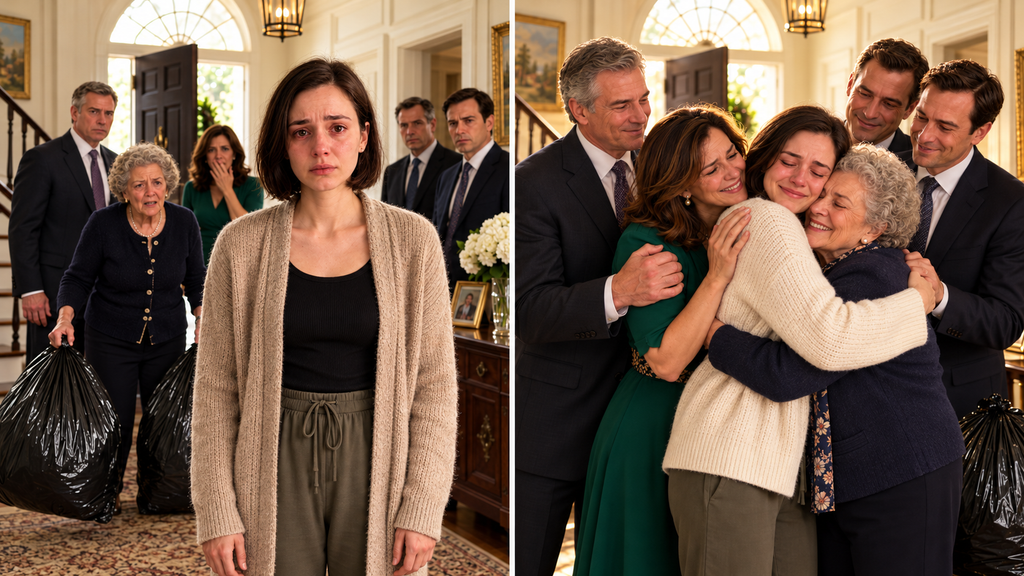
And sometimes, in the loneliest moments, I imagined my mother throwing her arms around me and saying there had been a terrible mistake.
But I had never imagined this.
My mother standing in Grandpa’s hallway, her face white with fear.
My father frozen beside the staircase.
My sister staring at two sheriff’s deputies as though they had walked into the wrong house.
And Uncle Richard standing in the doorway of Grandpa’s study, holding the same worn leather briefcase I remembered from every important day of my childhood.
“Richard,” my father said, forcing a laugh. “What is all this?”
Uncle Richard didn’t smile.
“Good morning, Arthur.”
He stepped into the hallway.
Behind him stood Deputy Caroline Hart, a broad-shouldered woman with kind eyes and a voice that could turn a crowded room silent.
The younger deputy beside her, whose badge read Morales, remained near the study door.
I recognized Deputy Hart.
She had come to the hospital two months earlier when Grandpa had needed an ambulance.
She had held the front door open while the paramedics carried him out.
And when I started crying, she’d quietly brought me a glass of water.
Now she looked at me.
“Good morning, Clara.”
“Morning,” I whispered.
My mother took a step forward.
“This is completely unnecessary. We’re Samuel’s family.”
Uncle Richard tilted his head.
“Interesting choice of words.”
“What is that supposed to mean?”
“It means you seem to remember being family whenever there’s property involved.”
Dad’s jaw tightened.
“Richard, I don’t appreciate your tone.”
“And I didn’t appreciate watching my brother wait seventeen years for a phone call from his son.”
The hallway became terribly quiet.
I could hear the grandfather clock in the dining room.
Tick.
Tick.
Tick.
The same clock Grandpa had wound every Sunday evening.
The same clock he had taught me to read when I was six.
The same clock that had continued ticking through every Christmas my parents missed.
My mother folded her arms.
“Samuel was a difficult man. You know that.”
Uncle Richard looked at her.
“No, Victoria. Samuel was a patient man. There’s a difference.”
Chloe appeared at the top of the stairs.
“Can somebody tell me what’s going on? The movers are waiting.”
Deputy Hart raised her voice.
“Ma’am, please ask the movers to stop handling the furniture until we’ve clarified what’s happening.”
Dad bristled.
“These are family belongings.”
Uncle Richard opened his briefcase.
“Actually, Arthur, that’s the first thing we’re going to discuss.”
He removed a thick blue folder and placed it on the hallway table.
My mother stared at it.
Something changed in her expression.
It was subtle.
But I saw it.
Recognition.
Fear.
“Where did you get that?” she asked.
Uncle Richard rested one hand on the folder.
“From Samuel.”
“That’s impossible.”
“Why?”
“Because he—”
She stopped.
Uncle Richard waited.
“Because he what, Victoria?”
My mother swallowed.
“Because Samuel wasn’t in any condition to make decisions before he died.”
For the first time, Uncle Richard smiled.
But there was nothing warm about it.
“Thank you,” he said softly. “I was hoping you’d say that.”
Dad looked sharply at her.
“Victoria, stop talking.”
Too late.
Uncle Richard turned toward me.
“Clara, your grandfather left very specific instructions about this morning.”
My throat tightened.
“I know.”
“Did you follow them?”
I looked at the garbage bags.
At the moving truck outside.
At Chloe’s suitcase sitting near the staircase.
“Every word.”
He nodded.
“Good girl.”
Those two words nearly broke me.
Grandpa used to say them when I brought home a good report card.
When I learned to ride a bicycle.
When I made my first loaf of bread without burning it.
When I finished high school.
I had not realized how desperately I needed to hear them again.
Uncle Richard pulled out a document.
“Arthur. Victoria. Before we go any further, you need to understand something.”
He paused.
“Samuel did not leave this house to either of you.”
My father stared at him.
“That’s ridiculous.”
“He placed the house into a living trust twelve years ago.”
Mom’s expression hardened.
“A trust?”
“Yes.”
“For whom?”
Uncle Richard turned the document around.
At the bottom of the page was Grandpa’s signature.
Above it was a name.
Mine.
Clara Evelyn Vance.
My mother moved closer.
“No.”
Uncle Richard said nothing.
She snatched at the page, but he pulled it away.
“No!” she repeated. “Samuel would never do that!”
“He did.”
“He had a son!”
“He had a granddaughter who loved him.”
Dad’s face darkened.
“I’m his only child.”
“And yet,” Uncle Richard replied, “you somehow managed to make him spend the last seventeen years feeling like he didn’t have one.”
Chloe came down three steps.
“Wait. Are you saying Clara owns this place?”
Uncle Richard looked at her.
“The trust owns the property. Clara is its successor trustee and the sole beneficiary of the house.”
Chloe blinked.
“But Mom said—”
“Your mother was mistaken.”
“She said Grandpa promised it to Dad.”
Uncle Richard’s voice sharpened.
“Your grandfather made no such promise.”
Dad grabbed the stair railing.
“This isn’t over. We can contest it.”
“You can speak to an attorney about any lawful options available to you.”
Uncle Richard closed the folder.
“But until a court says otherwise, neither you nor Victoria has any right to move into this house.”
My mother turned toward me.
For one impossible second, I thought she might apologize.
Instead, she pointed a trembling finger at my face.
“You manipulated him.”
The words landed harder than I expected.
“You stayed here all those years, filling his head with lies about us!”
I stared at her.
“All those years?”
“Don’t play innocent.”
“Mom.”
My voice sounded strange.
Small.
Almost like the voice I’d had when I was five.
“You left me here.”
She hesitated.
Only for a moment.
Then she lifted her chin.
“We did what we thought was best.”
I felt seventeen years of unanswered questions pressing against my chest.
“Best for whom?”
She didn’t answer.
Instead, Dad stepped between us.
“Enough. Richard, I want to see the original will.”
“You will receive the appropriate copies through the estate process.”
“And until then?”
Uncle Richard looked toward the front door.
“Until then, the moving truck leaves.”
My father laughed.
It was an ugly sound.
“You think two deputies and some papers are going to scare me out of my father’s house?”
“No,” Uncle Richard answered.
Then he reached into his briefcase again.
“I think what’s in this second folder might.”
1. THE DOCUMENT MY MOTHER NEVER EXPECTED TO SEE
The second folder was red.
Unlike the first, it wasn’t thick.
Inside were only four pages.
Uncle Richard handed one to Deputy Hart.
She studied it without speaking.
My father watched her.
“What is that?”
“A document submitted to a title company nine days ago,” Richard answered.
Mom went completely still.
Nine days ago.
Grandpa had still been alive.
Barely.
He had been lying in a hospital bed, his breathing uneven, his hands cold beneath the blankets.
I remembered those nine days perfectly.
I had slept in a chair beside him.
I had fed him ice chips.
I had read aloud from his favorite western novel, even when he was too tired to answer.
And during those final days, my parents hadn’t visited once.
Not once.
Uncle Richard continued.
“Someone attempted to begin a transfer of this property using what appears to be a power of attorney from Samuel.”
Dad’s face changed.
“That doesn’t prove anything.”
“No,” Richard agreed. “Which is why we’ve requested a formal investigation.”
He turned the document around.
A signature appeared near the bottom.
Samuel Vance.
It looked like Grandpa’s handwriting.
Almost.
The letters were the same.
The sweeping S.
The narrow a.
The long underline beneath his last name.
But something about it bothered me.
I stepped closer.
“Can I see?”
Richard held the page where I could examine it.
And I saw it.
Grandpa always signed his name with a tiny upward curve at the end of the e.
He said it was something his own father had taught him.
A signature should look like it was smiling.
This one didn’t.
The e ended in a sharp, downward line.
I felt a chill.
“That’s not his signature.”
My father scoffed.
“You’re suddenly a handwriting expert?”
“No.”
I looked up.
“I’m his granddaughter.”
For seventeen years, Grandpa had signed school permission slips, birthday cards, doctor’s forms, bank deposits, Christmas letters, and notes he tucked into my lunchbox.
I knew his signature better than I knew my own.
Uncle Richard nodded.
“That’s one reason the document was flagged.”
Mom glanced toward the kitchen.
“Arthur, we should leave.”
But Dad wasn’t listening.
He stared at Richard.
“Who told you about the transfer?”
“The title company contacted Samuel’s legal office because the document conflicted with the recorded trust ownership.”
“That was a misunderstanding.”
“Was it?”
Dad swallowed.
“We were trying to simplify things.”
“By using a power of attorney that Samuel had revoked three years ago?”
The color drained from Dad’s face.
Mom whispered, “Arthur.”
Richard’s voice remained calm.
“And by submitting a signature Samuel’s attending physician has already said he could not have written in that physical condition?”
Dad opened his mouth.
Nothing came out.
For the first time in my life, I watched my father struggle to find words.
It should have satisfied me.
Instead, I felt sick.
Grandpa had been dying.
While I was sitting beside his bed, holding his hand and praying for one more morning, they had been trying to take his home.
The home where he had loved me.
The home where he had grown old.
The home where I had promised him I would be all right.
Deputy Hart stepped forward.
“Mr. Vance, we’re not making a final determination about the document here. But we’re investigating a suspected attempted fraudulent property transfer.”
Dad forced a smile.
“Well, that’s something our lawyers can straighten out.”
“Possibly,” she replied. “For now, we’re also here because you’ve begun moving property from a residence without the occupant’s consent.”
He pointed toward the stairs.
“That’s my father’s furniture.”
Richard interrupted him.
“Would you like to know who paid for most of that furniture?”
Dad glared.
“Don’t be ridiculous.”
“The oak dining table?”
Richard looked at me.
“Clara restored it when she was sixteen.”
I remembered.
Grandpa had found it beside a dumpster.
We had spent three weekends sanding away scratches and rubbing walnut oil into the wood.
“The grandfather clock?”
Richard continued.
“Samuel inherited it from his mother. It is specifically listed among Clara’s personal bequests.”
My mother looked toward the living room.
“What about the piano?”
“Clara’s.”
“The antique china?”
“Clara’s.”
“The silver candlesticks?”
“Clara’s.”
With every answer, my mother’s face grew angrier.
Finally, she shouted, “Did he leave anything to his own son?”
Richard didn’t reply immediately.
He looked toward me.
Then back at Dad.
“Yes.”
My father straightened.
Something greedy and hopeful flashed across his face.
“What?”
Uncle Richard opened a small envelope.
He took out a single folded sheet of paper.
“Samuel left you a letter.”
Dad stared at it.
“And?”
“That is all.”
For a moment, nobody moved.
Then Chloe let out a startled laugh.
“You’re kidding.”
Richard shook his head.
“No.”
Dad’s cheeks reddened.
“A letter?”
“Yes.”
“After everything?”
Richard’s eyes narrowed.
“After everything.”
Dad snatched the envelope.
He tore it open.
I watched his eyes move across the handwritten page.
At first, he looked confused.
Then furious.
Finally, something strange happened.
His expression collapsed.
His shoulders sagged.
And he looked away.
Mom grabbed his arm.
“What does it say?”
He folded the paper.
“Nothing.”
“Arthur.”
“It’s nothing.”
But Uncle Richard spoke.
“Samuel asked me to make sure you understood one particular sentence.”
My father looked at him with open hatred.
Richard continued.
“He wrote, ‘I spent seventeen years waiting for you to remember you had a father, but I will not let you forget you had a daughter.’”
The room went silent.
I pressed one hand against my mouth.
Grandpa.
Even after everything, he had been thinking of me.
My father crushed the letter in his fist.
“You always took his side.”
Richard’s expression barely changed.
“No, Arthur.”
He glanced at Grandpa’s photograph on the hallway wall.
“I stood beside the man who stayed.”
And then my mother said something that made the room turn colder.
“Samuel wouldn’t have dared do this if he thought we’d tell Clara the truth.”
I looked at her.
“What truth?”
Dad spun around.
“Victoria. Shut up.”
But my mother was staring at me now.
And for the first time that morning, she smiled.
It was not a kind smile.
“Oh, sweetheart,” she said. “You really don’t know why we left you here, do you?”
2. THE LIE THAT HAD FOLLOWED ME SINCE I WAS FIVE
I had imagined this moment a thousand times.
The explanation.
The reason.
The answer to the question that had followed me from kindergarten to college.
Why didn’t they come back?
My mother stood in the center of Grandpa’s hallway, surrounded by people who had finally stopped listening to her orders.
But she still had one thing she thought she could use against me.
The past.
“You were never an easy child, Clara.”
Dad closed his eyes.
“Don’t.”
She ignored him.
“You cried constantly. You refused to listen. You threw tantrums over everything.”
I stared at her.
“I was five.”
“You were difficult.”
“I was five.”
“You had problems.”
The words struck something buried deep inside me.
I suddenly remembered sitting on the floor of my childhood bedroom.
My small pink suitcase beside me.
Mom standing in the doorway.
Her expression exhausted.
“Stop crying, Clara. You’re making everything harder.”
I had forgotten that sentence.
Or perhaps I had spent seventeen years trying to forget it.
My mother continued.
“Your grandfather always spoiled you. Every time we tried to discipline you, he interfered.”
Richard’s voice became sharp.
“Victoria.”
“No. She deserves to know.”
She looked directly at me.
“Your father and I were struggling. We had bills. We had your sister. And you required so much attention.”
Chloe frowned.
“What do I have to do with this?”
Mom waved her away.
“Nothing, honey.”
But Chloe didn’t move.
“Then why did you mention me?”
My mother’s voice rose.
“Because Clara was always jealous of you!”
I felt my stomach twist.
Jealous?
I remembered Chloe as a toddler with blond curls and bright red shoes.
I remembered sharing crackers with her on the back porch.
I remembered trying to teach her the words to a silly song.
I had loved her.
She was my little sister.
Mom had made sure I didn’t get to watch her grow up.
“That’s not true,” I whispered.
“Of course it is.”
“No.”
Mom took another step.
“You need to understand that your grandfather wasn’t some saint. He took advantage of our problems. He wanted you here.”
Richard spoke quietly.
“Then tell her about the hospital.”
My mother froze.
I turned toward him.
“The hospital?”
Richard’s expression changed.
For the first time, I saw something like uncertainty.
“Clara…”
“What hospital?”
Grandpa had told me so much about my childhood.
He told me about the first time I rode my bicycle.
About the day I broke his kitchen window with a baseball.
About the night a thunderstorm frightened me so badly that he sat beside my bed until morning.
But there were gaps.
Dark spaces in my memory that never quite made sense.
I knew I had been sick as a small child.
I had a thin scar below my ribs.
Grandpa said I’d had an operation when I was little.
He never made a mystery of the scar.
But I didn’t know much about the months surrounding it.
Richard looked at my parents.
“Are you going to tell her?”
Dad shook his head.
“This has nothing to do with the house.”
“Doesn’t it?”
My uncle’s voice trembled with anger.
“Samuel sold the north pasture to pay for her surgery. You remember that, Arthur?”
My father said nothing.
My eyes filled with tears.
“What surgery?”
Richard turned toward me.
“You were four, sweetheart. You had a serious congenital condition that required an operation and a long recovery.”
I instinctively touched my scar.
He continued.
“Your grandfather helped arrange the treatment when your parents couldn’t cover all the expenses.”
I remembered hospital lights.
A stuffed yellow rabbit.
Someone singing beside my bed.
A large hand holding mine.
Grandpa.
“The operation was successful,” Richard said. “But you needed follow-up care. Medication. Appointments. Someone who could stay home with you.”
I looked at my mother.
“And you didn’t want to?”
Her lips tightened.
“That’s an unfair way to describe it.”
“Then describe it fairly.”
She stared at me.
Richard answered instead.
“Your parents asked Samuel to keep you for a weekend while they dealt with some financial problems.”
My heart began pounding.
“Yes. I know that part.”
“The weekend ended. Samuel called.”
I swallowed.
“They said they needed another week.”
Richard nodded.
“Then another.”
He paused.
“Eventually, Samuel drove to their house.”
I looked at Dad.
“What happened?”
My father stared at the floor.
Richard took a slow breath.
“They told him they couldn’t manage both children anymore.”
Chloe gasped.
I heard the sound as though from far away.
Both children.
Two daughters.
One they had kept.
One they had left.
The truth was so simple that it seemed impossible.
They had made a choice.
And I had been the child they chose not to keep.
My mother threw up her hands.
“Do you know how hard life was back then? Arthur had lost his job. We were behind on the mortgage. Chloe was barely three!”
“And Clara was five,” Richard said.
My mother glared at him.
“Samuel offered to take her!”
“After you told him you couldn’t bring her home.”
“He could afford it!”
“He sold land to pay her hospital bills!”
“Well, he had land to sell!”
Those seven words seemed to echo through the house.
He had land to sell.
As though Grandpa’s sacrifices had cost him nothing.
As though his love had been convenient.
As though seventeen years of bedtime stories, scraped knees, homework, illnesses, nightmares, school plays, and lonely birthdays were merely a financial arrangement.
I looked at my father.
“Did you ever want to come back for me?”
He raised his head.
For one second, I saw something in his eyes.
Regret.
Maybe even shame.
Then my mother grabbed his arm.
“Arthur, don’t answer that.”
And suddenly, I knew something important.
My mother had spent seventeen years controlling the story.
But Grandpa had left me a way to hear the parts she’d hidden.
Richard took a small brass key from his pocket.
“Clara, there’s something else in the study.”
He placed the key in my palm.
“It’s in the bottom drawer of Samuel’s desk.”
My fingers closed around the familiar brass.
“What is it?”
Richard looked toward my mother.
“The reason Victoria begged your grandfather never to tell you what happened that winter.”
Mom’s face drained of color again.
“Richard…”
But he was already turning toward the study.
“Come with me, Clara.”
3. THE DRAWER GRANDPA KEPT LOCKED
The study smelled exactly as it always had.
Old paper.
Leather.
Wood polish.
And the faint trace of pipe tobacco that seemed woven into the curtains.
Sunlight fell across Grandpa’s desk.
His reading glasses rested beside an unfinished crossword puzzle.
A blue fountain pen lay diagonally across the blotter.
I stared at them.
Yesterday, I had stood at his grave and watched men lower his coffin into the earth.
This morning, his glasses were still waiting for him.
His chair was still pushed back at the angle he preferred.
There was a half-empty jar of peppermints beside his lamp.
For one terrible instant, I wanted to forget everything happening outside.
I wanted to sit in his chair, put my face in my hands, and cry until the whole house disappeared.
Richard gently closed the door behind us.
The deputies remained in the hallway with my family.
“Take your time,” he said.
I shook my head.
“If I take my time, I don’t think I’ll be able to do this.”
He nodded.
I knelt beside the desk.
The bottom drawer had a tiny brass keyhole.
When I was little, I used to ask Grandpa what he kept inside.
He always gave the same answer.
“Things too important to lose.”
I had assumed he meant money.
Or expensive watches.
Or old legal documents.
Now my hands trembled as I turned the key.
The lock clicked.
I pulled.
The drawer slid open.
Inside was a small wooden box.
Its lid was scratched.
A faded yellow ribbon had been tied around it.
Across the top, written in Grandpa’s unmistakable handwriting, were four words.
FOR MY LITTLE CLARA.
I stopped breathing.
Richard moved closer.
“Samuel prepared that box a long time ago.”
I lifted it carefully.
The ribbon was so old that its edges had begun to fray.
I untied it.
Inside were dozens of envelopes.
Photographs.
A child’s hospital bracelet.
A pink hair clip.
A tiny paper crown made from yellow construction paper.
And beneath them, a folded piece of notebook paper.
I recognized the handwriting immediately.
Not Grandpa’s.
Mine.
The letters were crooked and oversized.
Some were backward.
I unfolded it.
Dear Mommy and Daddy,
I am being good.
Grandpa says I am a big girl now.
I did not cry today except a little.
Can you come get me soon?
I will share my toys with Chloe.
I promise I won’t be bad anymore.
Love, Clara.
I didn’t realize I’d started crying until a tear fell onto the paper.
The ink blurred slightly beneath it.
I pressed the letter against my chest.
“Oh, Grandpa…”
Richard looked away.
I knew he was trying to give me privacy.
But I couldn’t stop.
I remembered writing that letter.
Not every word.
Not every detail.
But I remembered sitting at the kitchen table, holding a fat purple crayon, asking Grandpa how to spell promise.
I remembered carefully drawing a heart at the bottom.
I remembered giving it to him and asking him to mail it.
And I remembered checking the mailbox every afternoon.
For weeks.
“Did he send it?” I whispered.
Richard nodded.
“Yes.”
I looked down.
“Then why is it here?”
“Your mother returned it.”
I lifted my head.
“What?”
He reached into the wooden box.
Beneath the photographs was a yellowed envelope.
The edges were torn.
Across the front was my parents’ old address.
On the back were three words, written in my mother’s handwriting.
Stop encouraging this.
My knees almost gave way.
Richard steadied the box.
“Samuel kept it because he couldn’t bear to throw it away.”
I stared at the envelope.
For seventeen years, I had wondered whether my parents knew I missed them.
Whether they realized I waited.
Whether they understood how much a little girl could hurt.
They had known.
They had received my letter.
And they had sent it back.
I couldn’t breathe properly.
“Why would she do that?”
Richard’s voice softened.
“I don’t know every answer, Clara. But I know your grandfather tried.”
He showed me another envelope.
Then another.
Birthday invitations.
School photographs.
A kindergarten graduation announcement.
A Christmas card I’d decorated with cotton-ball snow.
Each carried a date.
Each had been returned, ignored, or answered with a short refusal.
One had been sent when I turned eight.
Dear Mom and Dad,
We are having chocolate cake on Saturday.
Grandpa says I can invite anyone.
I would like you and Chloe to come.
Love, Clara.
My mother had written across the invitation:
We already have plans.
I remembered that birthday.
I remembered the chocolate cake.
The eight candles.
The little pink dress Grandpa had bought at the department store.
I remembered standing by the living room window long after the other children had gone home.
Waiting for headlights.
Waiting for a car.
Waiting for people who had already decided not to come.
I sank into Grandpa’s chair.
For a long time, I couldn’t speak.
Then I asked Richard the question that hurt most.
“Did Grandpa know they weren’t coming?”
Richard’s face crumpled.
“He hoped they would.”
I wiped my cheeks.
“Why didn’t he tell me?”
“Because you were a child.”
He sat in the chair opposite me.
“And because Samuel believed that if you were going to stop waiting for your parents, it should be because you were ready, not because somebody forced your heart to break.”
I looked down at the box.
There was one more envelope.
It was newer.
White.
Sealed.
My name was written across it.
Richard pointed toward it.
“That one is from Samuel.”
I opened it with shaking hands.
Inside was a letter.
My dearest Clara,
If you’re reading this, then I suppose I’ve finally lost the argument with time.
A broken laugh escaped me.
That sounded exactly like Grandpa.
I’ve spent most of my life repairing things.
Engines, fences, clocks, broken chairs, leaky roofs.
You used to tell me I could fix anything.
But there was one thing I could never repair, no matter how hard I tried.
I couldn’t make your parents love you the way you deserved.
I covered my mouth.
For years, I thought that was my failure.
Then I watched you grow.
I watched you become kind without being weak, strong without becoming cruel, and generous even when life gave you reasons not to be.
And I realized I hadn’t failed at all.
My job was never to make them love you.
My job was to make sure their failure didn’t teach you that you were unlovable.
I bent forward.
The sob came from somewhere so deep inside me that it frightened me.
Richard moved beside the chair.
He placed a hand on my shoulder.
I kept reading through my tears.
Clara, this house has always been yours in every way that mattered.
You filled it with laughter when I thought my laughing days were over.
You gave an old man a reason to plant tomatoes every spring, because you insisted they tasted better than the ones from the store.
You taught me how to use that ridiculous phone with the glowing screen.
You sat beside me on my worst days and pretended not to notice when I was afraid.
You were never a burden.
You were the best thing that ever happened to me.
I pressed my forehead against the page.
Outside the study, I heard my mother raising her voice.
But it sounded distant.
Unimportant.
For the first time since the funeral, Grandpa felt close enough to touch.
I continued.
There are things I didn’t tell you while I was alive.
Not because I didn’t trust you.
Because I wanted you to have as many ordinary days as possible before the world tried to turn your life into a fight.
The blue folder explains the house.
Richard will explain the trust.
But the small envelope at the very bottom of the box explains something else.
I looked down.
There was another envelope.
Smaller.
Cream-colored.
Sealed with red wax.
I opened it.
Inside was a single photograph.
My mother.
My father.
Chloe.
And me.
We were standing outside our old house.
I was holding my little sister’s hand.
On the back, Grandpa had written a date.
Seventeen years ago.
And beneath it:
The last photograph they took before they made their choice.
But there was something else.
A second line.
Ask Richard about the agreement they signed the following Monday.
I lifted my head.
“What agreement?”
Richard looked at the door.
Then back at me.
“Clara, your parents didn’t simply forget to pick you up.”
A terrible feeling spread through my chest.
“What do you mean?”
He took a breath.
“Three weeks after leaving you here, they came back.”
My heart stopped.
“They came back?”
“Yes.”
I gripped the armrests.
“To get me?”
Richard’s silence was worse than any answer.
I whispered it again.
“Did they come back for me?”
He shook his head.
“No, sweetheart.”
And then he told me why.
4. THE PRICE THEY PUT ON MY CHILDHOOD
“Your parents came back because they wanted money.”
I stared at Richard.
For several seconds, I couldn’t understand the words.
Money?
What money?
Grandpa had never been wealthy when I was a child.
He had a pension.
A small savings account.
The old house.
A few acres of land.
And a truck that rattled whenever he turned left.
We bought groceries with coupons.
He patched his own work boots.
I wore hand-me-down sweaters from a neighbor whose daughter had outgrown them.
How much money could my parents possibly have wanted?
Richard leaned forward.
“Arthur and Victoria were behind on their mortgage. They had creditors calling. Samuel had already paid part of your medical expenses. They knew he would do almost anything to protect you.”
I shook my head.
“No.”
“I wish it weren’t true.”
“What did they ask him for?”
“Forty thousand dollars.”
I looked at him.
“Forty thousand?”
“Yes.”
“Why?”
Richard hesitated.
“They said they would consider taking you back if Samuel refused to help them.”
For a moment, I heard nothing.
Not the clock.
Not the voices outside.
Not even my own breathing.
My parents had used me as leverage.
A frightened little girl who still slept with a stuffed rabbit.
Who needed follow-up medical care.
Who cried when she saw school buses because she wondered if they would take her home.
They had used me to get money.
“What did Grandpa do?”
Richard’s eyes glistened.
“He refused to let your future depend on another payment.”
I looked at him.
“How?”
“He hired a family-law attorney. He insisted that any long-term arrangement be handled through the court.”
Richard paused.
“Your parents eventually agreed to legal guardianship.”
“But the money?”
“He helped settle certain medical bills directly. He did not hand them the forty thousand dollars they demanded.”
I stared at the floor.
“And they signed the papers?”
“Yes.”
“Just like that?”
Richard’s voice turned bitter.
“Not quite. There were arguments. Threats. Weeks of discussions. But in the end, they signed.”
I felt physically ill.
For seventeen years, I had believed that perhaps my parents had been overwhelmed.
Perhaps they’d been frightened.
Perhaps they had made a terrible mistake and didn’t know how to fix it.
But this was different.
They had made decisions.
Signed documents.
Discussed money.
Gone home.
And left me behind.
I wiped my face.
“Why didn’t Grandpa tell me when I got older?”
Richard sighed.
“Because he knew what you’d do.”
“What?”
“You’d start calculating what you were worth.”
I stared at him.
He continued.
“You’d look at forty thousand dollars and think that was the number your parents put on your life.”
My throat tightened.
“Wasn’t it?”
“No.”
He leaned closer.
“That number tells you something about them, Clara. Nothing about you.”
I wanted to believe him.
But my chest hurt.
“Did Grandpa ever regret taking me?”
Richard looked genuinely startled.
“Regret?”
I nodded.
“He gave up so much. The land. His retirement. All those years…”
Richard rose.
He walked to Grandpa’s bookcase and took down a framed photograph.
It showed me at seven years old, missing two front teeth, sitting on Grandpa’s shoulders at the county fair.
We were both laughing.
Richard placed it in my hands.
“Do you know what Samuel told me the first Christmas you were here?”
I shook my head.
“He said, ‘Richard, I thought I was getting too old to raise a child.’”
My heart squeezed.
Richard smiled through his tears.
“Then he said, ‘Turns out I was getting too old to live without one.’”
I broke.
There was no other word for it.
I cried until my shoulders shook.
Until my throat ached.
Until Richard knelt beside the chair and held me the way Grandpa used to when I had a nightmare.
But somewhere inside all that grief, something shifted.
For seventeen years, I had felt like the child who had been left behind.
Now I was beginning to understand something different.
I had also been the child someone chose to keep.
Every morning.
Every birthday.
Every ordinary, unremarkable Tuesday.
Grandpa had chosen me.
Again and again.
And the people waiting outside his study couldn’t take that away.
Eventually, I folded his letter.
I placed it carefully back inside the envelope.
Then I stood.
Richard studied my face.
“Are you ready?”
I looked toward the door.
“Yes.”
He picked up the wooden box.
“There’s one more thing you should know.”
I almost laughed.
“Of course there is.”
Richard’s expression darkened.
“Your parents didn’t come back today just because Samuel died.”
I froze.
“What do you mean?”
“They’ve been making plans for this property for months.”
I remembered the moving truck.
Chloe claiming the master bedroom.
Dad ordering the movers upstairs.
Mom arriving with garbage bags.
All of it had happened too quickly.
Too confidently.
As though they’d already decided exactly how the day would unfold.
“What kind of plans?”
Richard looked directly at me.
“Plans involving a developer, a large advance payment, and a contract they had no legal authority to sign.”
My stomach dropped.
“How much money?”
Richard answered quietly.
“Two hundred and eighty thousand dollars.”
I stared at him.
“Two hundred and eighty thousand?”
He nodded.
“And Clara…”
I waited.
“They’ve already spent most of it.”
5. THE HOUSE THEY HAD ALREADY SOLD
When Richard and I returned to the hallway, my father was speaking urgently into his phone.
“No. Don’t cancel anything yet.”
He turned his back when he saw us.
“Just give me another hour.”
My mother stood near the front door with her arms folded.
Chloe sat on the staircase, her sunglasses pushed onto her head.
She looked pale.
The movers were waiting outside beside their truck.
Nobody was touching anything.
Deputy Hart stood near the doorway, watching my father.
Richard stepped forward.
“Arthur, I assume you’re speaking with Mr. Bennett.”
Dad lowered his phone.
His expression changed.
“How do you know that name?”
“Because his attorney called my office yesterday.”
My mother looked sharply at Dad.
“You said that was handled.”
Richard heard her.
“No, Victoria. It isn’t handled.”
I looked from one face to another.
“Who is Mr. Bennett?”
Richard answered.
“Daniel Bennett. He owns a regional property development company.”
Chloe frowned.
“Like the new shopping center outside town?”
“Exactly.”
My stomach tightened.
There had been rumors for months about a company buying land near our neighborhood.
New shops.
Apartment buildings.
A widened road.
Some neighbors were excited.
Others were angry.
Grandpa hated the idea.
He said the town already had too many places to spend money and not enough places for children to ride bicycles.
But he had never said anyone approached him about selling.
Richard turned toward my parents.
“Mr. Bennett’s company has been interested in purchasing several adjoining properties, including Samuel’s.”
Mom lifted her chin.
“Which is perfectly reasonable.”
“Yes. Except Samuel rejected their offer.”
Dad looked away.
Richard continued.
“After his rejection, someone representing themselves as authorized to act for him reopened the negotiations.”
My father said nothing.
“An agreement was signed. Money changed hands. And certain promises were made about delivering clear title.”
I stared at Dad.
“You sold Grandpa’s house?”
He snapped, “We didn’t sell anything!”
Richard answered before I could.
“Technically, Clara, the final sale was never completed. They accepted an advance under an agreement they had no authority to make.”
My mother interrupted.
“That money was an investment.”
“An advance tied to a fraudulent claim of ownership is not an investment.”
Dad turned toward Richard.
“Watch what you’re accusing me of.”
Richard met his eyes.
“Then tell Clara what you did.”
My father looked at me.
For the first time, I saw fear beneath his anger.
“The developer offered a good price.”
“How much?”
He hesitated.
I asked again.
“How much?”
Richard answered.
“Two million eight hundred thousand dollars.”
The number seemed unreal.
Two million eight hundred thousand dollars.
For the old house where Grandpa had taught me to tie my shoes.
The yard where we’d planted sunflowers.
The kitchen where I’d burned pancakes.
The little upstairs bedroom where I’d spent years falling asleep to the sound of rain.
Dad noticed my expression.
“You see? This is why we had to act. Samuel didn’t understand what he was sitting on.”
I stared at him.
“He understood exactly where he lived.”
Dad ignored me.
“Clara, listen. This is enough money to change all our lives.”
I looked at him.
“Our lives?”
“Yours too.”
His voice softened.
Suddenly, he sounded almost fatherly.
Almost concerned.
“We can work something out. You’re young. You don’t want the responsibility of maintaining a place this size.”
I felt a cold anger rise inside me.
“You don’t know what I want.”
“Clara, be practical.”
“You haven’t spoken to me in seventeen years.”
“That doesn’t mean I stopped being your father.”
I looked him directly in the eyes.
“No. It means you stopped acting like one.”
His mouth closed.
My mother rushed forward.
“Enough of this emotional nonsense. We’re talking about an enormous amount of money!”
There it was.
The truth.
Not love.
Not family.
Not grief.
Money.
I looked at the old wallpaper.
At the polished banister.
At Grandpa’s coat hanging beside the door.
They saw a fortune.
I saw my childhood.
The difference suddenly felt so enormous that I wondered if we had ever belonged to the same family at all.
Richard opened the red folder again.
“The advance was two hundred and eighty thousand dollars. According to the developer’s attorney, Mr. Bennett paid it after receiving assurances that Arthur had valid authority to arrange the transaction.”
Dad’s face grew dark.
“That agreement is confidential.”
“Not from the parties and investigators dealing with the suspected fraud.”
I looked at Dad.
“Where’s the money?”
He didn’t answer.
Mom spoke instead.
“Some of it went toward expenses.”
“What expenses?”
“Family obligations.”
I almost laughed.
“Whose family?”
She glared.
“Don’t be insolent.”
Chloe stood.
“Mom.”
Victoria turned.
“What?”
“Did you use any of that money for my apartment?”
Mom hesitated.
“Sweetheart, that’s not relevant.”
Chloe moved down another step.
“Did you?”
Her voice was different now.
Less entitled.
More frightened.
My mother looked at Dad.
He stared at the floor.
Chloe’s face changed.
“Oh my God.”
I looked at her.
She whispered, “You told me Grandpa wanted to help.”
Dad tried to interrupt.
“Chloe—”
“You said he was finally making things right with us.”
My sister started shaking.
“You said he wanted me to have a fresh start after graduation.”
Mom reached for her.
“Darling, he would have wanted that.”
Chloe pulled away.
“Did he actually say that?”
No answer.
“Did Grandpa give me that money?”
Silence.
Then Richard spoke.
“No, Chloe.”
She put a hand over her mouth.
For the first time that morning, my sister looked at the house without claiming any part of it.
And I realized something unexpected.
I wasn’t the only daughter my parents had lied to.
6. THE LAST TIME MY FATHER SPOKE TO GRANDPA
My father sank onto the lowest stair.
He rubbed his forehead.
“This has gotten out of control.”
Mom whirled toward him.
“Don’t you dare start.”
He looked exhausted.
“Victoria, enough.”
“Enough? We’ve worked for months!”
Richard’s gaze sharpened.
“Months?”
My mother realized what she’d said.
But she couldn’t take it back.
Dad stood again.
“We weren’t trying to hurt anyone.”
I stared at him.
“Then why did you need me out of the house?”
He looked at the garbage bags.
“That was your mother’s idea.”
Mom gasped.
“Arthur!”
“You brought the bags!”
“And you brought the truck!”
Their voices rose.
I watched them argue over responsibility like two children fighting over a broken window.
The difference was that the broken thing was my life.
Richard waited.
Then he said, “There is something else.”
Everyone went silent.
He removed a small tablet from his briefcase.
“Samuel installed security cameras last spring.”
Dad’s head snapped up.
“What?”
“After someone tried to access the garage without permission.”
My mother swallowed.
Richard continued.
“One of those cameras records the front porch.”
I remembered helping Grandpa position it.
He said he’d grown tired of raccoons tipping over the trash cans.
I had believed him.
Perhaps that was partly true.
But Grandpa had always been good at giving people a gentle explanation when he wanted to protect them from something uglier.
Richard tapped the screen.
A grainy image appeared.
Our front porch.
The date in the corner showed a Tuesday three months earlier.
Grandpa stood near the doorway wearing his brown cardigan.
He looked thinner than I remembered.
His cane rested against his leg.
Facing him was my father.
I stopped breathing.
Arthur.
Standing on the porch.
Three months ago.
While I had been at work.
They had seen each other.
Grandpa hadn’t told me.
My father stared at the screen.
“Turn that off.”
Richard didn’t.
The video began playing.
Dad’s voice came through the small speaker.
“I’m trying to help you, Dad.”
Grandpa answered.
“Then ask how Clara is doing.”
Dad shifted.
“We don’t have time for this.”
“You’ve had seventeen years.”
My heart twisted.
Grandpa sounded tired.
But unmistakably himself.
Dad leaned toward him.
“That property is worth more than you know. The developers are offering serious money.”
Grandpa shook his head.
“I know what they offered.”
“Then why won’t you sell?”
“Because it’s not yours to sell.”
Dad became visibly agitated.
“I’m your son.”
Grandpa looked directly at him.
And even through that tiny speaker, his voice carried a strength I recognized.
“Then why do you only come here when you want something?”
No one moved.
In the video, Dad stepped closer.
“You always favored Clara.”
Grandpa’s answer came immediately.
“I favored the child who was here.”
My father looked as though someone had struck him.
On the recording, he laughed bitterly.
“You know what? Fine. Keep the house. But don’t expect me to stand around and pretend that girl didn’t turn you against your own family.”
Grandpa’s face changed.
Not anger.
Not surprise.
Disappointment.
Deep, tired disappointment.
“Arthur, that girl is your daughter.”
Dad waved a hand.
“She’s twenty-two. She doesn’t need me anymore.”
Grandpa looked toward the camera.
Then back at his son.
“She needed you when she was five.”
My eyes filled with tears.
Dad said something I almost missed.
“She had you.”
Grandpa answered so quietly that Richard turned up the volume.
“Yes. She did.”
Then he straightened.
“And thank God for that.”
The recording continued.
Dad demanded the property.
Grandpa refused.
Dad threatened to challenge the estate.
Grandpa told him the documents were already in order.
Finally, my father walked away.
Before leaving, he turned around.
“You’ll regret cutting me out.”
Grandpa remained on the porch.
“The only thing I regret is that you made it necessary.”
The video ended.
For several seconds, nobody spoke.
Then Chloe whispered, “Grandpa was right.”
Dad turned toward her.
“What?”
She looked at him with tears in her eyes.
“He was right. You didn’t even ask about Clara.”
My father shook his head.
“Chloe, you don’t understand the pressure we’ve been under.”
“No.”
She stepped away from him.
“I don’t think I understand either of you.”
Mom rushed toward her.
“Honey, please.”
Chloe backed up.
“Don’t.”
And that single word wounded my mother more visibly than anything I had said all morning.
It was the first time her favored daughter had refused her.
But Grandpa wasn’t finished speaking to us.
Richard placed the tablet on the hallway table.
“There’s another recording.”
My mother shook her head.
“No.”
Richard looked at me.
“This one is for Clara.”
He took a breath.
“Samuel recorded it eleven days before he died.”
I pressed a hand against my chest.
Eleven days.
That was before his final decline.
Before the breathing machines.
Before the long nights when he drifted in and out of sleep.
I whispered, “Can I see him?”
Richard nodded.
“Of course.”
He opened the file.
And suddenly, there he was.
My grandpa.
Sitting in his study.
Wearing his favorite green sweater.
His hair combed neatly to the side.
His old reading glasses balanced on his nose.
Alive.
Looking straight at the camera.
“Well,” he began, smiling a little, “if Richard has managed to make this contraption work, I suppose you’re seeing me.”
I laughed.
A broken, tearful laugh.
Grandpa looked down at something in his hands.
Then back into the lens.
“Clara, sweetheart, I hope you’re sitting down.”
My knees weakened.
I sat on the stairs.
He continued.
“I’ve asked Richard to show you this only after the funeral, and only when you’re ready.”
He paused.
“I have a feeling Arthur and Victoria will make that decision easier than it should be.”
Behind me, my mother made a strangled sound.
But I couldn’t look away from the screen.
Grandpa smiled sadly.
“I wish I could tell you why some people can look at a child and see a responsibility they don’t want.”
His eyes glistened.
“I’ve never understood it.”
I wiped my cheeks.
“But I do know something.”
He leaned forward.
“When you came to live here, I was lonely.”
My breath caught.
“I hadn’t told anyone that. Not even Richard.”
He chuckled.
“Especially Richard. He gets too smug when he’s right about something.”
Richard lowered his head, smiling through tears.
Grandpa continued.
“I thought my life was mostly finished. Your grandmother was gone. My son hardly visited. This old house had become so quiet that I could hear the pipes creaking at night.”
He paused.
“Then a little girl arrived with one suitcase, a yellow rabbit, and a question she asked me every morning.”
His voice softened.
“‘Is today the day Mommy comes back?’”
I began sobbing.
Grandpa looked down.
“For a while, I didn’t know what to say.”
He took off his glasses.
“I couldn’t promise you they’d return.”
His eyes lifted.
“But I could promise that I wouldn’t leave.”
I pressed both hands over my face.
On the recording, Grandpa continued speaking.
“And Clara, I want you to understand something very clearly.”
He raised one finger.
The way he always did when he wanted me to remember a lesson.
“You did not ruin my retirement.”
He raised another.
“You did not steal my peace.”
Another.
“You did not cost me the life I wanted.”
His voice broke slightly.
“You gave me a life worth staying for.”
I bent forward.
I could barely breathe.
Grandpa waited a moment on the recording.
Then he smiled.
“Now, about this house.”
My mother lifted her head.
He continued.
“I know what Arthur will say. He’ll say blood matters. He’ll say the property should stay in the family.”
Grandpa shook his head.
“Well, I’ve got news for him.”
He leaned closer.
“Family isn’t a word you use to claim furniture.”
His voice grew firmer.
“Family is a promise you keep when nobody is watching.”
Richard closed his eyes.
Grandpa looked straight ahead.
“I made that promise to a little girl seventeen years ago.”
He paused.
“And I intend to keep it, even after I’m gone.”
I was crying too hard to see clearly.
But I heard every word.
“Clara, the house is yours to protect, change, sell, or keep. I hope it brings you happiness. But I don’t want you staying here out of guilt. It is a gift, not a chain.”
He smiled.
“And don’t let anyone tell you that being kind means allowing yourself to be hurt.”
His expression grew serious.
“Sometimes the kindest thing you can do for yourself is close the door.”
A long silence followed.
Then he whispered:
“I love you, little bird.”
My heart stopped.
Little bird.
He hadn’t called me that in years.
When I was small, I had been terrified of thunderstorms.
Grandpa would sit beside my bed and tell me that even the tiniest bird could survive the strongest wind if it found somewhere safe to rest.
He always ended by saying:
“Sleep now, little bird. Your nest is safe.”
The recording ended.
I sat completely still.
Richard turned off the tablet.
No one spoke.
Not my father.
Not my mother.
Not Chloe.
Even the deputies seemed reluctant to break the silence.
Finally, I stood.
I looked at my parents.
And something inside me changed.
I no longer needed them to understand why Grandpa had loved me.
I no longer needed them to admit what they had done.
I no longer needed them to give me permission to belong.
I was home.
I had always been home.
And they were strangers standing in my hallway.
“Please leave,” I said.
My mother stared at me.
“What?”
“Take your moving truck and leave.”
She laughed incredulously.
“Clara, you cannot be serious.”
“I am.”
“After everything we’ve just heard?”
I looked at her.
“Especially after everything we’ve just heard.”
Dad stepped forward.
“Clara, we need to discuss the developer.”
“Discuss it with your lawyer.”
“This affects you!”
“You made sure of that.”
Mom’s voice rose.
“You ungrateful little—”
Deputy Hart moved.
“Mrs. Vance.”
My mother stopped.
The deputy’s voice was firm.
“Clara has told you to leave. You need to respect that.”
Mom looked around wildly.
At Richard.
At the deputies.
At Dad.
At Chloe.
Then she pointed toward me.
“This isn’t over.”
I held her gaze.
“No,” I said quietly. “I don’t think it is.”
And I was right.
Because before the moving truck could leave, a black SUV pulled into Grandpa’s driveway.
A tall man in a navy coat stepped out.
Behind him came a woman carrying a document case.
Richard looked through the window.
His expression darkened.
“Well,” he murmured, “that complicates things.”
I turned.
“Who is it?”
He looked at my father.
“Arthur’s business partners have arrived.”
7. THE MEN WHO CAME TO COLLECT
The man introduced himself as Daniel Bennett.
He was in his late fifties, with silver hair and the exhausted expression of someone who had spent too much of his life cleaning up other people’s mistakes.
The woman beside him was his attorney, Meredith Shaw.
They approached the porch slowly.
Bennett looked at the moving truck.
Then at the deputies.
Then at my father.
“Arthur,” he said. “What exactly is going on?”
My father rushed forward.
“Daniel, this is a misunderstanding.”
Bennett didn’t shake his hand.
“Is it?”
“Yes.”
“Then why did my attorney receive a letter yesterday stating that you had no authority to represent the property owner?”
Dad glanced toward Richard.
“Because my uncle has always had a problem with me.”
Meredith Shaw stepped forward.
“Mr. Vance, we reviewed the recorded trust documents this morning. We also reviewed the information concerning the purported power of attorney.”
My father looked trapped.
“There are details you don’t understand.”
She opened her case.
“Then perhaps you can explain why the trust was not disclosed when our company asked for proof of title.”
Mom interrupted.
“Excuse me, but this is a private family matter.”
Bennett turned toward her.
“Mrs. Vance, my company advanced two hundred and eighty thousand dollars based on representations made by you and your husband.”
Victoria opened her mouth.
He raised a hand.
“Before you tell me this is a misunderstanding, I need you to understand something.”
His voice grew cold.
“I did not become a developer by failing to recognize when someone is lying to me.”
My father looked toward the deputies.
“Can we discuss this somewhere else?”
Meredith nodded.
“Through counsel, certainly. Our immediate priority is protecting our company’s position and preserving the evidence.”
Bennett glanced toward the house.
“Who actually controls this property?”
Richard gestured toward me.
“Clara is the successor trustee and sole beneficiary of the real property.”
Bennett looked surprised.
“Clara?”
I stepped forward.
“Yes.”
He studied me.
I was still wearing Grandpa’s flannel shirt.
My hair was tangled.
My eyes were swollen.
I must have looked more like a grieving child than the person standing between him and a multimillion-dollar deal.
But his expression changed.
He removed his hat.
“I’m sorry about your grandfather.”
The kindness startled me.
“Thank you.”
“I met Samuel twice.”
I blinked.
“You did?”
Bennett nodded.
“He was a difficult negotiator.”
Despite everything, I smiled.
“That sounds like him.”
Bennett looked toward the oak trees.
“He told me he wasn’t interested in selling the property.”
I waited.
“He said he’d spent too much of his life making things grow here to watch someone tear them down.”
My throat tightened.
Bennett continued.
“At our last meeting, he asked me whether I had grandchildren.”
I looked at him.
“What did you say?”
“I told him I had three.”
A small, embarrassed smile crossed his face.
“He showed me a photograph of you.”
I stopped breathing.
“Me?”
Bennett nodded.
“He said you were the reason he was keeping the house.”
I looked toward the window of the study.
Grandpa.
Even in a business negotiation, he’d been talking about me.
Bennett’s expression turned serious.
“I don’t know what your parents told you, but I now understand that Samuel did not authorize this transaction.”
“No,” I whispered. “He didn’t.”
Meredith closed her folder.
“We won’t be seeking to enforce this agreement against you or the trust based on what we’ve found. Our counsel will handle our claims against the people who accepted the advance.”
My father took a step back.
“You can’t do that.”
Bennett looked at him.
“Arthur, you accepted money for something you didn’t own.”
“We had an understanding!”
“With whom?”
“My father!”
Bennett glanced at Richard.
Richard said nothing.
Finally, my father shouted, “He was supposed to leave it to me!”
Bennett’s expression became flat.
“That isn’t the same as owning it.”
The words hung in the autumn air.
For seventeen years, Dad had thought being Samuel’s son entitled him to everything Grandpa possessed.
Even the things he had never helped build.
Even the memories he had never shared.
Even the home he had never visited.
Bennett looked back at me.
“Miss Vance, I’m sorry this happened the day after your grandfather’s funeral.”
I nodded.
He lowered his voice.
“For what it’s worth, he seemed very proud of you.”
I couldn’t answer.
I could only smile through my tears.
Then Deputy Morales stepped outside.
“Mr. Bennett, Ms. Shaw, we’d like to obtain copies of any relevant documents for the investigation.”
Meredith nodded.
“Of course.”
My parents exchanged a look.
A frightened one.
And for the first time, I realized they were no longer worried only about losing the house.
They were worried about what might happen when the truth reached people who weren’t related to them.
8. MY SISTER’S FIRST HONEST QUESTION
The movers left shortly after noon.
One by one, they carried their empty dollies back into the truck.
The driver gave me a sympathetic nod.
He told me they had been instructed to remove everything from the house.
Furniture.
Artwork.
Boxes.
Even the old tools in Grandpa’s shed.
Everything.
Dad had hired them to empty my home before I had finished mourning.
I stood at the living room window as the truck’s engine started.
Mom and Dad remained on the porch, speaking with Deputy Hart and Richard.
Their voices drifted through the glass.
Angry.
Insistent.
Defensive.
I had stopped listening.
Then someone spoke behind me.
“Clara?”
I turned.
Chloe stood near the doorway.
Her sunglasses were gone.
Without them, she looked much younger.
There were tears on her cheeks.
“What?”
She looked down.
“Can I ask you something?”
I folded my arms.
“I guess.”
She glanced toward the hallway.
“Did you really write those letters?”
My chest tightened.
“What letters?”
“To Mom and Dad.”
I didn’t answer immediately.
Then I nodded.
“Yes.”
Chloe wiped her face.
“Mom told me you didn’t want to see us.”
I stared at her.
“What?”
She swallowed.
“She said you liked living with Grandpa. She said you thought we were boring and that you didn’t want to come home.”
I felt as though the floor had shifted beneath me.
“Chloe, I was five.”
“I know.”
Her voice broke.
“I know that now.”
She sat on the sofa.
For a while, she stared at her hands.
“Do you remember my third birthday?”
I shook my head.
“Not really.”
She nodded.
“I don’t remember much either. But I remember a cake with a pink butterfly on it.”
A memory flickered.
A kitchen.
Pink frosting.
A little girl clapping her hands.
Chloe looked at me.
“Mom said you ruined it.”
I frowned.
“What?”
“She said you threw cake at the wall because you were jealous.”
My stomach twisted.
I remembered the party.
Or at least pieces of it.
The butterfly cake.
The pink plates.
Chloe reaching for a candle.
And me trying to help her blow it out.
“I didn’t ruin your birthday.”
Chloe looked up.
“Grandpa told me.”
I froze.
“When?”
“At his funeral.”
I stared at her.
She took a shaking breath.
“I went up to him at the visitation.”
My heart squeezed.
“Before he died?”
She nodded quickly.
“About six months ago.”
I stood completely still.
Chloe had visited Grandpa?
“Why?”
She wiped her eyes.
“I was doing a project about old houses. Mom said Grandpa’s place was worthless and outdated, but I saw a photograph online and thought it was beautiful.”
I glanced at the wooden ceiling beams.
“Grandpa loved this house.”
“I know.”
Chloe looked ashamed.
“He invited me inside.”
The words cut.
A part of me wanted to ask why he hadn’t told me.
Another part already knew.
Grandpa had spent years hoping our family might find its way back together.
He wouldn’t have wanted to ruin even the smallest possibility.
Chloe continued.
“He showed me the garden. And the workshop. And the photographs of you.”
I pressed my lips together.
“He told me you restored the dining table.”
I nodded.
“He said you were planning to study architectural conservation.”
I blinked.
“How did you know that?”
“Because he talked about you the entire time.”
My eyes burned.
Chloe gave a broken laugh.
“Seriously. I was there almost two hours, and I think he mentioned me twice.”
I looked down.
She continued.
“He showed me a little wooden toy box. It had butterflies painted on it.”
I remembered.
Grandpa had made it for Chloe’s third birthday.
A small cedar chest.
Pink butterflies on the lid.
We had wrapped it in yellow paper.
But Mom had never come to pick it up.
“He said you helped paint it,” Chloe whispered.
I nodded.
“I did.”
She stared at me.
“Then why did Mom tell me you hated me?”
The question struck like a blade.
“I don’t know.”
Chloe began crying.
“She told me you were jealous of everything I had. That you didn’t want a sister.”
I crossed the room and sat in the chair opposite her.
“Chloe, I used to ask Grandpa every Christmas whether I could send you a present.”
She looked at me.
“Really?”
“Every year.”
Her face crumpled.
“But I never got anything.”
I swallowed.
“I know.”
“Where did they go?”
I thought of the returned letters.
The unopened invitations.
My mother’s handwriting.
Stop encouraging this.
“I think Mom knows.”
Chloe bent forward.
For several minutes, she cried.
I didn’t hug her.
Not yet.
I wasn’t ready.
And something Grandpa said in his recording remained with me.
Being kind doesn’t mean allowing yourself to be hurt.
So I sat beside my sister without pretending seventeen years could disappear in one conversation.
Eventually, she lifted her head.
“There’s something I need to tell you.”
I looked at her.
“What?”
She glanced toward the front door.
“Mom and Dad didn’t just lie to Mr. Bennett.”
My stomach tightened.
“What do you mean?”
Chloe pulled out her phone.
“They asked me to sign something last month.”
I froze.
“Sign what?”
She swallowed.
“A witness statement.”
I sat straighter.
“What kind of witness statement?”
She unlocked the screen.
Her fingers trembled as she scrolled.
“They said Grandpa was too sick to understand his paperwork, and that I needed to help them protect the family property.”
I felt the blood drain from my face.
Chloe looked up.
“They wanted me to say I’d seen Grandpa sign an authorization.”
Richard’s words echoed in my mind.
The document was flagged.
The signature was questionable.
I leaned closer.
“Did you?”
Chloe shook her head.
“No.”
Relief flooded me.
Then she whispered, “But they sent it in anyway.”
I went cold.
“What?”
She turned the phone toward me.
On the screen was an email.
An attachment.
A witness statement bearing her name.
And beneath it, a signature that looked almost exactly like hers.
Chloe began shaking.
“Clara, I never signed that.”
I stared at the screen.
Then at my sister.
And suddenly the entire day became even uglier.
My parents had not only tried to steal Grandpa’s house.
They had been willing to use both of their daughters to do it.
9. THE EVIDENCE THAT CHANGED EVERYTHING
Richard was still on the porch when Chloe called him inside.
Mom and Dad had been told to leave the property.
They were gathering their belongings near the driveway.
But when Chloe showed Richard her phone, he immediately asked us to sit at the dining table.
He examined the email carefully.
Then looked at her.
“Chloe, I need you to tell me exactly what happened.”
She nodded.
Her hands were shaking so badly that I brought her a glass of water.
She stared at it.
“Mom called me on September eighteenth.”
Richard made a note.
“What did she say?”
“She said Grandpa was getting confused and Dad needed help organizing the property paperwork.”
My stomach tightened.
Chloe continued.
“She emailed me a form and told me to sign it.”
“Did you read it?”
“I did.”
“What did it say?”
“That I’d personally witnessed Grandpa signing a document and that he understood what he was doing.”
Richard nodded.
“And had you?”
“No.”
“Did you tell your mother that?”
“Yes.”
“What did she say?”
Chloe’s voice cracked.
“She said I was being dramatic. That everyone knew Grandpa wanted Dad to have the house.”
Richard looked at her.
“And then?”
“I told her I wasn’t comfortable signing anything I hadn’t witnessed.”
She rubbed her eyes.
“She got angry.”
I could almost hear Mom’s voice.
Don’t be difficult.
You’re embarrassing me.
After everything we’ve done for you.
Chloe continued.
“She said I was selfish. That Dad was under terrible financial pressure. Then she hung up.”
Richard leaned forward.
“When did you first see the completed statement?”
“This morning.”
She held up the phone.
“About twenty minutes ago. I searched my email because you mentioned the documents.”
He examined the attachment.
“May I forward these messages to my office and to the investigating deputy with your permission?”
Chloe nodded.
“Yes.”
Then she whispered, “Am I in trouble?”
Richard studied her.
“That depends on the facts, Chloe. But telling the truth now and preserving the original messages is important.”
She began crying again.
“I didn’t know.”
I watched her.
My little sister.
The child my parents had kept.
The girl who had walked into my home and casually claimed Grandpa’s bedroom.
She looked nothing like the confident woman who’d arrived that morning.
And suddenly, I understood that being loved by our parents had not necessarily meant being safe from them.
They had given Chloe expensive things.
Beautiful clothes.
Vacations.
A car.
An apartment.
But when they needed something from her, they had been willing to put her name on a false document.
Their love had strings.
Maybe it always had.
Richard turned toward me.
“Clara, I need to ask you something.”
I nodded.
“Did Samuel ever tell you he was worried about someone entering the property?”
I thought about the security cameras.
The new locks Grandpa had installed.
The way he’d started checking the front door twice each night.
“Yes.”
“When?”
“Last spring.”
“What did he say?”
I closed my eyes.
“He said people had been asking questions about the property.”
“Who?”
“He wouldn’t tell me.”
Richard made another note.
I hesitated.
“There’s something else.”
He looked up.
“Go on.”
“A few weeks ago, Grandpa asked me to photograph every room in the house.”
Richard’s eyes sharpened.
“Did you?”
“Yes.”
“All of them?”
“Every room. Even the shed.”
“Do you still have the photographs?”
I nodded.
“They’re in my cloud backup.”
He leaned back.
For the first time that day, I saw genuine relief on his face.
“Good.”
I frowned.
“Why?”
“Because if anyone later claims something was missing, altered, or removed before Samuel died, those photographs may help establish what was here.”
I glanced toward the hallway.
Toward the moving truck that had almost emptied the house.
Grandpa had thought of that too.
He had known.
Not exactly what would happen.
But enough.
Enough to protect the home even when he no longer had the strength to stand at the door himself.
Richard looked toward the porch.
“Samuel suspected your parents might make a claim after his death. He wanted an inventory because he had reason to believe they might try to take possession immediately.”
I swallowed.
“Why didn’t he tell me?”
“Because you were caring for him. He didn’t want your last weeks together consumed by this.”
I looked at Grandpa’s empty chair.
That sounded like him.
Always trying to spare me pain.
Even when he was the one suffering.
Chloe’s phone buzzed.
She looked down.
Her expression changed.
“It’s Mom.”
Richard said, “You don’t have to answer.”
Chloe stared at the screen.
Then pressed the button.
And put the phone on speaker.
“Hello?”
My mother’s voice erupted immediately.
“Where are you?”
Chloe swallowed.
“Inside.”
“Why?”
“Mom, I need to ask you something.”
“Not now. Get your things and come outside.”
Chloe looked at Richard.
He gave no instructions, only waited.
She took a breath.
“Did you sign my name on a witness statement?”
Silence.
Then Mom laughed.
“Oh, for heaven’s sake.”
Chloe’s hands trembled.
“Did you?”
“Sweetheart, those documents are complicated. Your father and I were just handling the paperwork.”
“That wasn’t my question.”
My mother’s voice hardened.
“Watch your tone.”
Chloe’s eyes filled.
“Mom, did you sign my name?”
Another silence.
Then:
“We were protecting your future.”
The words made my skin crawl.
Chloe whispered, “So you did.”
“Don’t twist this around. We did what was necessary.”
Richard wrote something on his notepad.
My mother continued.
“Your grandfather would have wanted us to take care of the estate.”
Chloe closed her eyes.
“No, Mom.”
“What?”
“He wouldn’t.”
My mother scoffed.
“Now you’re taking Clara’s side?”
Chloe flinched.
And I saw it.
The real weapon.
Not money.
Not threats.
The fear of losing a parent’s approval.
A fear I’d been forced to live without for so long that it no longer controlled me.
Chloe opened her eyes.
“I’m taking the side of what actually happened.”
Mom’s voice went icy.
“Then you can forget about coming home.”
The sentence struck me like a physical blow.
Seventeen years ago, those words had been spoken to me in a different form.
Now they were being used against Chloe.
She made a small wounded sound.
Then said:
“Okay.”
My mother paused.
“What?”
Chloe wiped her cheeks.
“I said okay.”
“Chloe—”
“You don’t get to threaten me with losing my family just because I won’t lie for you.”
For a moment, there was only breathing on the line.
Then my mother hissed:
“You’ll regret this.”
Chloe ended the call.
She sat completely still.
I looked at her.
She looked at me.
And I realized we had both heard the same door closing.
Only this time, neither of us was five years old.
10. THE WOMAN WHO CAME BACK WITH ONE LAST THREAT
My parents finally left just after one.
The moving truck drove away first.
Then Bennett’s SUV.
Then the deputies, after speaking with Richard and collecting the information they needed for their initial report.
Dad drove a silver sedan.
Mom sat in the passenger seat.
I watched from the porch as they pulled out of the driveway.
For the first time all morning, the street was quiet.
No engines.
No shouting.
No strangers on my lawn.
Only autumn leaves tumbling along the sidewalk.
I thought I would feel victorious.
Instead, I felt empty.
Like someone had opened a door inside me and let all the air escape.
Richard stood beside me.
“Are you all right?”
I let out a shaky breath.
“No.”
He nodded.
“That’s a reasonable answer.”
I looked toward Grandpa’s garden.
The tomato plants had gone brown.
A few late marigolds still bloomed near the fence.
“He knew they would come.”
“Yes.”
“He knew what they were like.”
Richard looked at me.
“He hoped they’d prove him wrong.”
I swallowed.
“Even at the end?”
“Especially at the end.”
Something inside me ached.
Grandpa had been betrayed by his son over and over.
Yet some part of him had still hoped Arthur might come back for the right reason.
Not the money.
Not the house.
Just love.
I understood that hope better than I wanted to.
Richard placed a hand on my shoulder.
“You don’t have to make any decisions today.”
I nodded.
Then I looked toward the staircase.
“Chloe?”
“She’s upstairs getting her suitcase.”
I hesitated.
“She can stay for lunch.”
Richard smiled faintly.
“That sounds reasonable too.”
He started toward the door.
Then my phone rang.
Unknown number.
I almost ignored it.
But something made me answer.
“Hello?”
A woman’s voice said, “Is this Clara Vance?”
“Yes.”
“My name is Lorraine Pierce. I’m an attorney in the next county. I’m calling because I was contacted earlier today about representing your parents.”
My stomach tightened.
“Okay.”
She paused.
“I want to make sure you understand that my clients believe there are grounds to question your grandfather’s estate arrangements.”
I glanced at Richard.
He noticed my expression.
“Clara?”
I raised one hand.
The woman continued.
“There may be concerns about undue influence during Samuel’s final illness.”
I felt cold.
Undue influence.
That was the accusation Grandpa had feared.
That I had manipulated an elderly man.
That I had stolen his house.
That I had taken advantage of the person who loved me most.
I swallowed.
“What are you asking me?”
“At this stage, nothing formal. I understand emotions are running high. Your parents may be willing to resolve matters privately.”
Richard held out his hand.
I told the woman that legal matters would need to go through the appropriate attorneys, then passed him the phone.
He listened for a moment.
“This is Richard Vance. I represent the trust.”
He paused.
“Yes, Ms. Pierce. We can communicate through counsel.”
Another pause.
“No, I won’t discuss settlement terms on an unsolicited call to a grieving twenty-two-year-old.”
His voice sharpened.
“Nor would I advise your clients to continue contacting her directly.”
He ended the call.
I stared at him.
“They’re going to say I manipulated Grandpa?”
“They may try.”
“What if people believe them?”
Richard’s expression softened.
“Clara, the truth doesn’t become less true because somebody tells a louder story.”
I shook my head.
“But people love gossip.”
“Yes.”
“And Mom is good at making herself sound like the victim.”
“Yes.”
I looked at the driveway.
“What if they take everything?”
Richard turned toward me.
“Look at me.”
I did.
“Your grandfather took his estate planning seriously. The trust documents were established years before his final illness. There are records of his decisions, medical assessments, communications with independent professionals, and the history of your care for him.”
I swallowed.
“Does that mean they can’t win?”
“No attorney should promise that.”
His honesty frightened me.
But it also made me trust him.
“What I can tell you is that we have substantial evidence of Samuel’s intentions.”
I looked away.
“Grandpa shouldn’t have had to spend his last months protecting me from his own son.”
Richard sighed.
“You’re right.”
Then he said something I would remember for years.
“Samuel couldn’t choose the son he raised. But he could choose what he left behind.”
I looked back toward the study window.
For the first time, I understood that Grandpa’s careful planning had not been about punishing my parents.
It had been about keeping a promise.
Your nest is safe.
And even dead, he was trying to make those words true.
11. THE FIRST NIGHT WITHOUT HIM
That evening, Richard went home.
Chloe decided not to return to our parents’ house.
She asked if she could sleep on the sofa until she figured out where to go.
I told her she could stay in the guest room for a few nights.
Not the master bedroom.
Not Grandpa’s room.
The little guest room overlooking the garden.
She accepted without complaint.
Before going upstairs, she stood in the kitchen doorway.
“Clara?”
I was washing two coffee mugs.
“Yeah?”
“Thank you.”
I nodded.
She hesitated.
“I’m sorry about what I said this morning.”
I looked at her.
“The master bedroom?”
Her cheeks reddened.
“Everything.”
I dried my hands.
“Chloe, you didn’t know Grandpa.”
She winced.
“I know.”
“You didn’t know what he meant to me.”
Her eyes filled.
“I’m starting to.”
I wanted to say more.
I wanted to tell her how angry I was.
How unfair it felt that she could appear out of nowhere, claim the best room, then ask to stay in the same house she’d been prepared to take from me.
I wanted to ask why she’d never searched for me.
Why she’d believed every cruel thing our mother said.
Why it had taken Grandpa’s death for her to look at me like a human being.
But I was exhausted.
So I simply said:
“We can talk tomorrow.”
She nodded.
“Okay.”
After she went upstairs, I turned off the kitchen lights.
The house settled around me.
Old floorboards creaked.
Wind moved through the oak branches outside.
The radiator clicked as it cooled.
I stood alone in the dark.
For seventeen years, Grandpa had been somewhere in this house.
Reading in his study.
Watching the evening news.
Working in the shed.
Cooking something suspiciously overcooked in the kitchen.
Now there was no one.
I walked into the living room.
His armchair faced the fireplace.
His favorite blanket was folded over the back.
A book lay open beside the lamp.
I picked it up.
A western.
Of course.
Grandpa loved western novels.
He claimed they were educational because they taught people the importance of good boots, loyal horses, and not trusting strangers who smiled too much.
I sank into his chair.
It still smelled faintly of his aftershave.
For a moment, I could almost hear him.
“You’re up past your bedtime, little bird.”
And suddenly, the strength I’d held onto all day disappeared.
I cried.
Not because of my parents.
Not because of the house.
Not because of the lawyers or the money or the lies.
I cried because I wanted my grandpa.
I wanted to tell him what had happened.
I wanted to ask whether I’d done the right thing.
I wanted him to say I was being too hard on myself.
I wanted him to make tea and pretend he wasn’t worried.
I wanted one more ordinary evening.
Just one.
I pressed my face into his blanket.
“Grandpa,” I whispered, “I don’t know how to do this without you.”
The silence answered.
Then something slipped from the folds of the blanket.
A little white envelope.
It fell onto my lap.
I stared at it.
My name was written across the front.
In Grandpa’s handwriting.
Clara — for your first quiet night.
I covered my mouth.
He had known.
Somehow, he had known I’d end up here.
In his chair.
With his blanket.
Missing him so badly that breathing hurt.
I opened the envelope.
Inside was a short letter.
Little bird,
If you’ve found this, I suspect you’ve been trying to be brave all day.
You don’t have to be brave tonight.
Cry if you need to.
Be angry.
Miss me.
I will not think any less of you.
When morning comes, make yourself breakfast. Open the curtains. Feed the birds.
And remember that a house doesn’t stop being a home when one person leaves it.
It becomes the place where their love keeps living.
One more thing.
Don’t spend the rest of your life fighting people who wouldn’t fight to keep you.
Spend it loving the ones who stay.
Always,
Grandpa.
I read the letter three times.
Then I held it against my heart.
Outside, the wind moved through the trees.
For the first time since the funeral, the silence no longer felt entirely empty.
It felt like the space Grandpa had left for me to become whoever I was going to be.
I closed my eyes.
And cried until sleep finally came.
But while I slept, my parents were making another plan.
One that would bring their lies into the open in a way neither they nor I could have predicted.
12. THE LIE THEY TOLD THE WHOLE TOWN
The next morning, I woke to the sound of my phone vibrating.
At first, I thought it was my alarm.
Then I realized there were dozens of notifications.
Text messages.
Missed calls.
Messages from people I hadn’t spoken to since high school.
I sat up in Grandpa’s chair, where I’d fallen asleep beneath his blanket.
My back ached.
My eyes were swollen.
And my phone wouldn’t stop buzzing.
The first message was from my old school friend, Emma.
Clara, please call me before you look at Facebook.
My stomach tightened.
The next message was from Mrs. Alvarez, my former elementary school teacher.
Sweetheart, I saw what your mother posted. Please know that I remember what really happened.
I went cold.
What had my mother posted?
I opened Facebook.
And there it was.
A photograph of Victoria standing beside Grandpa’s grave.
She was wearing black.
Her hand rested against his headstone.
Her eyes were closed, her face arranged into an expression of profound sorrow.
I had never seen that photograph before.
Then I read the caption.
Yesterday, we said goodbye to my beloved father-in-law, Samuel Vance.
Unfortunately, our family is facing another tragedy.
For years, our estranged daughter Clara lived with Samuel and slowly isolated him from the people who loved him most.
During his final illness, documents were changed, access was restricted, and family members were kept away.
We have now discovered that Clara may have influenced a vulnerable elderly man into leaving her assets that rightfully belonged to the family.
We are heartbroken, but we will fight for the truth.
I stopped reading.
My hands went numb.
They were accusing me of isolating Grandpa.
The man I’d bathed when he couldn’t stand.
The man I’d driven to appointments.
The man whose medications I’d organized.
Whose meals I’d cooked.
Whose final breath I’d witnessed.
My mother was telling the world that I had used him.
The post had already been shared hundreds of times.
Some comments were sympathetic.
Praying for your family.
So sorry you’re dealing with this.
Elder abuse is heartbreaking.
Others were cruel.
That girl should be ashamed.
I hope they take everything back.
Some people will do anything for inheritance money.
I stared at the words until they blurred.
Then I saw a comment that made my blood run cold.
It was from someone who had attended Grandpa’s funeral.
I wondered why Clara seemed so calm yesterday. Now it makes sense.
Calm?
I’d barely been able to stand.
I’d gripped the edge of Grandpa’s coffin so tightly that Uncle Richard had to help me release it.
I’d cried until my body had nothing left.
But apparently grief could now be measured by strangers who didn’t know me.
I closed the app.
My phone rang.
Emma.
I answered.
“Clara?”
Her voice broke when she heard mine.
“Oh, sweetheart.”
That was all it took.
I began crying.
She didn’t ask questions.
She didn’t tell me to calm down.
She simply stayed on the line until I could speak.
Finally, I whispered, “Why would she do this?”
Emma sighed.
“Because she’s trying to control the story before the truth comes out.”
I wiped my face.
“I don’t know how to fight this.”
“You don’t have to fight it alone.”
A knock came at the living room door.
I looked up.
Chloe stood there holding her phone.
Her face was pale.
“I saw it,” she whispered.
I told Emma I’d call her back.
Chloe stepped inside.
“Clara, I swear I didn’t know they were going to do this.”
I looked at her.
“Do you believe what she wrote?”
Chloe stared at me.
Then shook her head.
“No.”
I wanted that answer to make everything better.
It didn’t.
I looked toward Grandpa’s photograph.
“They’re going to destroy his memory.”
Chloe’s eyes filled.
“No.”
She sat beside me.
“They’re not.”
Then she opened her phone.
“I have something.”
I frowned.
“What?”
She scrolled through a series of old messages.
“Mom sent these to me when Grandpa was in the hospital.”
I leaned closer.
One message read:
Arthur says the old man won’t cooperate. We need the transfer finished before Clara starts asking questions.
Another:
Don’t mention the developer if anyone asks.
And another:
Once the house is ours, Clara can complain all she wants.
I stared at the screen.
Chloe whispered, “I didn’t understand what she meant then.”
I looked at her.
“And now?”
Her expression changed.
“Now I do.”
She stood.
“I’m calling Uncle Richard.”
I nodded.
Then she hesitated.
“Clara?”
“What?”
“Mom taught me to believe that whoever speaks the loudest must be right.”
She looked at the messages again.
“But Grandpa was quiet.”
My throat tightened.
She continued.
“And he was the only one telling the truth.”
13. THE FIGHT THEY COULDN’T WIN WITH LIES
Over the next several weeks, my parents tried everything.
They hired an attorney.
They challenged the trust.
They repeated their accusations that I had isolated Grandpa and influenced his decisions.
They claimed he had been confused.
That he hadn’t understood what he was signing.
That I had taken advantage of his declining health.
Each accusation hurt.
But Richard had been right.
Grandpa had prepared.
The trust had been created twelve years earlier, long before his final illness.
There were signed records of his intentions.
Documents showing that he’d reviewed the arrangements repeatedly.
Medical records from the relevant periods.
Letters to his attorneys.
And evidence of the ordinary, loving relationship we’d shared for seventeen years.
Then there were Grandpa’s videos.
Not just the one from his study.
The security recordings.
The conversations with Dad.
The photographs.
The messages.
And something I hadn’t expected.
People began coming forward.
Mrs. Alvarez wrote a statement about the little girl who waited by the classroom window every Friday, hoping her parents might finally arrive.
Our former neighbor, Mr. Peterson, remembered Grandpa teaching me to ride a bicycle when I was six.
The owner of the local pharmacy remembered Grandpa picking up my prescriptions and asking questions about my care after the surgery.
My college advisor remembered Grandpa attending every exhibition of my restoration projects, even when walking across campus exhausted him.
And Emma…
Emma brought a photograph.
It showed Grandpa sitting in the front row at my high school graduation.
His hands were clasped.
His face was shining with pride.
Beside him sat an empty chair.
Emma had asked him that day why he’d saved the seat.
He’d told her:
“Just in case Clara’s father changes his mind.”
I held that photograph for a long time.
Even then.
Even after thirteen years.
Grandpa had left room for my father.
My parents told the world I’d kept them away.
But Grandpa had spent years making room for them to come closer.
They were the ones who refused.
The first major court hearing took place on a rainy Thursday morning, several months after the funeral.
I wore a navy dress Grandpa had bought me for my college scholarship interview.
It had always made me feel brave.
Richard met me outside the courthouse.
Chloe stood beside him.
She had agreed to give evidence about the statement bearing her signature.
She was nervous.
So was I.
“Clara,” she whispered, “what if Mom hates me forever?”
I looked at her.
The question felt horribly familiar.
For most of my childhood, I’d asked some version of it.
What if Mommy doesn’t love me?
What if I did something wrong?
What if she never comes back?
I took a breath.
“Chloe, you can’t make someone love you by helping them hurt somebody else.”
Her eyes filled.
She nodded.
“I know.”
But I could tell it still hurt.
Inside the courthouse, my mother wore a dark blue suit and pearls.
Her hair was perfectly styled.
Her face was composed.
She looked like a grieving daughter-in-law fighting for justice.
My father sat beside her.
He appeared older than he had the morning of the moving truck.
When he saw me, he looked away.
Mom didn’t.
She stared.
Cold.
Accusing.
As though I had betrayed her.
I wondered whether she had ever considered that I might have wanted my mother beside me that day.
Not sitting across the room as an adversary.
Not accusing me of stealing from a dead man.
But holding my hand.
Telling me Grandpa would be proud.
For one moment, I allowed myself to feel the loss of that possibility.
Then I let it go.
The hearing was not a dramatic television trial.
There were no sudden gasps every five minutes.
There were documents.
Questions.
Testimony.
Objections.
Long explanations of dates and signatures.
But the truth emerged piece by piece.
And each piece made my parents’ story harder to sustain.
Richard’s witnesses explained Grandpa’s decisions.
The medical evidence did not support the claim that he’d lacked capacity when the trust arrangements were made.
The recorded conversation showed that he clearly understood the property and his intentions shortly before his final illness.
Then Chloe testified.
I watched my sister walk to the witness stand.
Her hands trembled.
She took the oath.
And for the first time in her life, she told the truth about our parents in a room where they couldn’t simply order her to be quiet.
The attorney asked whether she had witnessed Grandpa signing the property authorization.
“No,” Chloe answered.
“Did you sign the witness statement submitted under your name?”
“No.”
“Did you authorize anyone else to sign it?”
“No.”
My mother’s face hardened.
The attorney presented the email messages.
Chloe identified them.
Then came the question that seemed to break something inside her.
“Why didn’t you come forward sooner?”
She lowered her head.
For a moment, I thought she might not answer.
Then she lifted her eyes.
“Because I was afraid my mother would stop loving me.”
The courtroom became still.
Her voice trembled.
“But I realized she was asking me to prove my loyalty by lying.”
She looked toward our mother.
Then toward me.
“And I didn’t want to become the kind of person who could abandon my sister twice.”
I pressed a hand against my mouth.
Chloe wiped her cheeks.
“I don’t know if Clara will ever forgive me.”
She took a breath.
“But she deserves the truth whether she forgives me or not.”
I began crying.
Not loudly.
Just quiet tears slipping down my cheeks.
For the first time, Chloe wasn’t asking me to accept her version of the past.
She was giving me back the truth our parents had taken.
The hearing continued.
The court did not immediately resolve every possible dispute.
But the evidence supporting my parents’ challenge grew weaker, while the investigation into the property documents continued separately.
Their attorney eventually withdrew the unsupported allegations of undue influence.
The remaining challenge to the trust was dismissed.
Grandpa’s instructions stood.
The house remained mine to care for through the trust.
And when we walked outside the courthouse, I felt something I hadn’t expected.
Not triumph.
Not revenge.
Relief.
The kind that comes when you’ve been holding your breath for years and finally realize you can let it out.
Richard touched my shoulder.
“How do you feel?”
I thought for a moment.
Then I answered:
“Like I can go home.”
He smiled.
“Then let’s get you there.”
14. MY FATHER FINALLY ASKED THE QUESTION
I was halfway down the courthouse steps when I heard him.
“Clara.”
My father’s voice.
I stopped.
Richard glanced at me.
“You don’t have to speak with him.”
I knew.
That knowledge felt new.
I didn’t have to speak to my father.
I didn’t have to explain my feelings.
I didn’t have to defend Grandpa.
I didn’t have to accept whatever excuses Arthur wanted to offer.
I could walk away.
But something inside me wanted to hear what he would say now that the house was no longer within his reach.
I turned.
Dad stood several steps above me.
His suit was wrinkled.
His hair looked thinner.
His shoulders sagged.
For the first time in my life, he seemed smaller than the man I’d built in my imagination.
“Can we talk?” he asked.
I looked at Richard.
He nodded.
“I’ll be nearby.”
Chloe went with him.
Dad and I stood beneath the courthouse awning while rain fell beyond the steps.
For a long time, he said nothing.
Then:
“I didn’t know Samuel had kept all those letters.”
I swallowed.
“Okay.”
He looked at me.
“I never saw most of them.”
I stared at him.
“Would it have mattered?”
He didn’t answer.
I waited.
Finally, he whispered, “I don’t know.”
It was the first honest thing I’d heard him say.
He rubbed his face.
“I told myself you were better off with Dad.”
I looked at him.
“I was.”
He flinched.
“I know.”
“You weren’t there.”
“I know.”
“You missed my birthdays.”
“I know.”
“My graduations.”
His eyes filled.
“I know.”
“Grandpa was sick, Dad.”
My voice broke.
“He was dying, and you couldn’t even come to see him without asking about the property.”
A tear slid down his face.
“I was ashamed.”
I stared at him.
“Of what?”
“Everything.”
He looked toward the street.
“At first, I told myself we’d bring you home once things settled down.”
I felt my chest tighten.
“But things never settled down?”
He shook his head.
“They did.”
The words landed heavily.
He continued.
“Your mother and I got back on our feet. I found work. We moved into a better house.”
I stared at him.
“Then why didn’t you come?”
Dad began crying.
“Because every year that passed made it harder to face what we’d done.”
I looked away.
For so long, I’d imagined some impossible explanation.
An accident.
A misunderstanding.
A terrible secret.
Something that would make sense of seventeen years.
But the truth was smaller.
Ugly.
Human.
They had done something cruel.
And instead of correcting it, they had built their lives around pretending it hadn’t happened.
I swallowed.
“So you just kept leaving me.”
He nodded.
“Yes.”
I wiped my cheeks.
“Grandpa told me not to waste my life trying to make people love me.”
Dad looked at me.
“He was a good man.”
I felt anger flare.
“He was more than a good man.”
My father lowered his head.
“He was.”
I took a breath.
“Why did you come back for the house?”
He looked ashamed.
“We were in trouble financially.”
I nodded.
“I know.”
“Your mother said Samuel would never leave everything to you.”
“She was wrong.”
“Yes.”
He swallowed.
“We convinced ourselves we deserved something.”
I looked into his eyes.
“You did deserve something.”
Hope flickered across his face.
I continued.
“You deserved the chance to know him while he was alive.”
His face crumpled.
“And you threw it away.”
For a long time, he couldn’t speak.
Then he whispered:
“Can you forgive me?”
There it was.
The question I had waited seventeen years to hear.
But standing there, I realized forgiveness wasn’t a door I could simply open because he finally knocked.
Not after the hospital.
Not after the letters.
Not after the moving truck.
Not after the lies.
I took a slow breath.
“I don’t know.”
He nodded.
“I understand.”
“No,” I said quietly. “I don’t think you do.”
He looked at me.
“You came back because you wanted the house. Now that you can’t have it, you’re asking whether you can have your daughter.”
He closed his eyes.
I continued.
“But you don’t know me.”
My voice trembled.
“You don’t know my favorite food.”
A tear slipped down my cheek.
“You don’t know that I hate driving in the rain because I was in a car accident when I was seventeen.”
He stared at me.
“You don’t know what I studied. You don’t know my friends. You don’t know that I was accepted into a restoration program last spring.”
I pressed my hand against my chest.
“You don’t know that I stayed awake for three nights straight when Grandpa’s fever wouldn’t break because I was terrified of losing the only parent I’d ever really had.”
Dad covered his mouth.
I whispered:
“You don’t get to skip the seventeen years and ask for the happy ending.”
He began sobbing.
And for the first time, I didn’t feel responsible for comforting him.
I let him cry.
Then I said:
“If you want to become someone I can trust, that won’t happen because you say you’re sorry.”
He nodded.
“It will take time.”
“I know.”
“And honesty.”
“Yes.”
“And you need to stop hurting people.”
He looked down.
“I will try.”
I studied him.
Trying was all he could promise.
And I was no longer willing to build my life around promises that might never be kept.
So I nodded.
“Goodbye, Dad.”
He whispered, “Goodbye, Clara.”
Then I walked down the courthouse steps.
I didn’t turn around.
Not because I hated him.
But because for once, I wasn’t waiting to see whether he would follow.
15. WHAT HAPPENED TO THE MONEY
The investigation continued long after the trust dispute ended.
The suspected false signatures, misleading title documents, unauthorized witness statement, and developer payment were examined separately.
Chloe cooperated.
So did the title company.
Daniel Bennett’s attorney supplied copies of the relevant correspondence and transaction records.
Richard helped coordinate the estate and trust documents, while other attorneys handled the criminal and civil matters.
The money had not simply vanished.
Part of it had been used to cover my parents’ debts.
Some had been spent on their lifestyle.
An expensive car.
Credit-card balances.
Chloe’s apartment.
And a series of payments Dad had described as business expenses.
They had spent years pretending to be more successful than they were.
The house was supposed to rescue them.
Their plan had been simple.
Claim ownership.
Push me out.
Finalize the sale.
Collect the remaining millions.
Then tell everyone they’d done what Grandpa wanted.
Except Grandpa had made sure the one person they planned to remove would be the one with the legal authority to stop them.
Months later, formal charges were brought in connection with the fraudulent property documents and representations.
My father eventually entered a guilty plea under an agreement that included restitution obligations and probation.
My mother fought longer.
She insisted the signatures were misunderstandings.
That she had simply been helping her family.
That Arthur was responsible for most of the decisions.
But the emails and messages contradicted her story.
When her case finally concluded, she too faced a criminal judgment, financial consequences, and court-supervised obligations.
The developer pursued recovery of the money from the people responsible.
The house itself was not sold to cover their mistakes.
Grandpa’s trust protected it from that claim.
There was no dramatic moment when I watched my parents dragged away in handcuffs.
No audience cheering.
No sudden feeling that justice had repaired my childhood.
Their lives changed through legal proceedings, financial losses, public embarrassment, and consequences they could no longer talk their way out of.
My mother’s Facebook post disappeared.
Then her account went quiet.
People who had accused me of stealing from Grandpa began sending apologies.
Some seemed sincere.
Some sounded as though they were embarrassed to have believed the wrong story.
I answered very few.
Because I’d learned something during those months.
People can apologize for judging you.
But they cannot always give back the peace they took.
And I didn’t want to spend the rest of my life begging strangers to understand what had happened in my own home.
I wanted to live.
Grandpa had made that possible.
It was time I started doing it.
16. THE THING GRANDPA LEFT MY SISTER
Spring arrived slowly.
The snow melted from the lawn.
The trees began budding.
And Grandpa’s garden woke up without him.
I found myself crying over the smallest things.
His gardening gloves.
The cracked watering can.
The packet of sunflower seeds he’d left in a kitchen drawer.
A grocery list that still said Clara’s favorite cereal.
But I also found myself laughing.
Sometimes when I remembered one of his ridiculous jokes.
Sometimes when I discovered he’d labeled a drawer IMPORTANT THINGS and filled it entirely with old batteries and rubber bands.
Sometimes when I caught myself talking to him while cooking.
“You would hate how much garlic I’m using,” I’d say aloud.
And for a moment, I could almost hear his answer.
“You call that cooking? That garlic has a family, Clara.”
I started restoring the house.
Not because it needed to be worth more money.
Because I wanted it to remain alive.
I refinished the kitchen cabinets.
Repaired the porch railing.
Cleaned the windows Grandpa always complained were impossible to reach.
And I kept his study exactly as it was for months.
I wasn’t ready to change it.
Chloe began visiting occasionally.
She had moved into a smaller apartment and found work at a design studio.
Our relationship was awkward.
Careful.
Sometimes we talked easily.
Sometimes we argued.
Sometimes I looked at her and remembered the girl who had claimed Grandpa’s bedroom before he was even cold in his grave.
And sometimes I saw the frightened little sister who had stood up in court and told the truth.
Both were real.
Healing didn’t mean pretending one of them had never existed.
One Saturday morning, Richard arrived carrying a small cedar chest.
I recognized it immediately.
The butterfly box.
The one Grandpa had made for Chloe’s third birthday.
Richard placed it on the dining table.
“Samuel asked me to give this to Chloe when the time was right.”
Chloe stared at it.
“For me?”
Richard nodded.
“Yes.”
She touched the lid.
The pink butterflies had faded.
One wing was chipped.
But the little brass latch still shone.
I remembered helping Grandpa paint it.
I remembered how seriously I’d taken the job.
I’d wanted it to be perfect.
Because it was for my baby sister.
Chloe opened the box.
Inside was a small stuffed bear.
A photograph.
And a folded letter.
She picked up the photograph first.
It showed the two of us sitting in Grandpa’s garden.
I was five.
She was three.
I was hugging her so tightly that she appeared to be trying to escape.
We were both laughing.
Chloe smiled through tears.
“I don’t remember this.”
“I do,” I whispered.
She looked at me.
“Really?”
I nodded.
“You kept eating the strawberries before Grandpa could wash them.”
Chloe laughed.
A real laugh.
The first one we’d shared without sadness waiting immediately behind it.
Then she unfolded the letter.
I watched her read.
Her face changed.
Tears filled her eyes.
She handed it to me.
“Can you read it?”
I nodded.
Grandpa had written:
Dear Chloe,
I made this box for you when you were three years old.
Clara helped me paint the butterflies.
She insisted every butterfly needed a different color because she said they would be lonely if they all looked the same.
You two were inseparable back then.
I wish you had been given the chance to stay that way.
Chloe pressed a hand over her mouth.
I continued.
I want you to know that I never blamed you for what happened.
You were a little girl too.
You were raised hearing things about your sister that were not true.
But you’re an adult now, and adulthood brings choices.
You can keep repeating the stories you were given.
Or you can become brave enough to ask whether those stories were fair.
Clara doesn’t owe you a relationship.
She doesn’t owe you trust simply because you share parents.
But if she ever gives you a chance, don’t waste it.
I looked at Chloe.
She was crying silently.
I finished the letter.
Your sister once spent an entire afternoon painting this box for you.
When she finished, she asked me if you would like it.
I told her you would.
I still believe that.
With love,
Grandpa Samuel.
For a long time, neither of us spoke.
Then Chloe looked at me.
“Clara?”
“Yeah?”
“Why did you paint butterflies?”
I smiled faintly.
“Because you liked them.”
She wiped her cheeks.
“You remembered?”
I looked at the little wooden box.
“I remembered everything I could.”
Chloe began sobbing.
She leaned toward me.
Then stopped.
“Can I hug you?”
The question caught me off guard.
For years, I’d imagined a reunion.
Some perfect moment where Chloe would run into my arms and everything would feel right.
But real life wasn’t like that.
We’d hurt each other.
There were years we couldn’t recover.
Questions we might never answer.
Still, I looked at my little sister.
And for the first time, I didn’t see the girl who’d arrived with a suitcase and a sense of entitlement.
I saw the little girl from the photograph.
The one who had loved pink butterflies.
The one I’d promised to share my toys with.
The one who had been kept away from me.
I opened my arms.
“Yeah,” I whispered. “You can.”
She fell against me.
We held each other.
And for a little while, two lost sisters were allowed to grieve the childhood neither of them had gotten to keep.
17. THE ROOM I FINALLY OPENED
By summer, I had made a decision.
I wasn’t selling the house.
Not because Grandpa had asked me to keep it.
He hadn’t.
He’d told me I was free to choose.
And for a while, I had considered leaving.
The rooms held so many memories.
Sometimes it hurt just to walk down the hallway.
But then I thought about the things Grandpa had taught me.
How to repair a broken chair.
How to sand a wooden floor.
How to look at something damaged and imagine what it could become.
I was twenty-two when he died.
I’d spent years studying architectural conservation and dreaming of restoring historic buildings.
Grandpa had encouraged that dream.
He had saved every sketch I made.
Every project photograph.
Every school certificate.
So I decided to turn part of the house into a small restoration studio.
A place where I could work.
Learn.
Build something of my own.
I started with the old garage.
The same place where Grandpa had taught me to hold a hammer.
The same place where he’d scolded me for using his best screwdriver to open a paint can.
The same place where he’d let me build a crooked birdhouse and proudly hung it from the porch, even though the birds refused to use it.
I cleaned the floor.
Repaired the windows.
Installed shelves.
Organized the tools.
And above the workbench, I hung a photograph of Grandpa holding my first wooden birdhouse.
Beneath it, I placed a small sign.
SAMUEL VANCE RESTORATION STUDIO
On opening day, Emma came.
Richard came.
Mrs. Alvarez came.
Mr. Peterson brought flowers from his garden.
A few neighbors stopped by.
Chloe arrived carrying a large box.
Inside was a new set of carving tools.
I stared at them.
“Chloe, these are expensive.”
She smiled.
“I know.”
“You didn’t have to.”
She shook her head.
“I wanted to.”
Then she glanced toward the house.
“Can I see Grandpa’s study?”
I hesitated.
For months, I’d kept that room closed.
Not locked.
Just untouched.
The books.
The desk.
The chair.
The green sweater still folded in the corner.
Some days, I’d stood outside the door with my hand on the knob and been unable to turn it.
But now I looked at Chloe.
And I thought about the morning after the funeral.
The moving truck.
The garbage bags.
The cruel words.
The study door opening.
Grandpa’s final plan unfolding.
I took a breath.
“Okay.”
We walked down the hallway together.
I opened the door.
Sunlight poured through the windows.
Dust floated through the air.
Grandpa’s desk stood beneath the old framed photograph of his parents.
Chloe walked in slowly.
She didn’t touch anything.
She simply looked.
“Wow,” she whispered.
I smiled.
“He loved this room.”
She nodded.
After a moment, she turned toward me.
“Can I ask you something?”
“Sure.”
“Did you ever feel like he loved you more than Mom and Dad did?”
I looked around the room.
At the books.
The photographs.
The worn carpet beneath Grandpa’s chair.
I thought about every night he’d sat beside my bed.
Every morning he’d made breakfast.
Every birthday he’d celebrated.
Every time he’d reminded me that I mattered.
Then I looked at my sister.
“Chloe, I don’t know how much Mom and Dad loved us.”
Her face softened.
“But I know Grandpa never made me guess.”
She nodded slowly.
Tears filled her eyes.
“I wish I’d known him better.”
My throat tightened.
“Me too.”
We stood in silence.
Then Chloe spotted something on the desk.
A small picture frame.
Inside was a photograph of Grandpa and me.
It had been taken on my eighteenth birthday.
I was wearing a blue dress.
Grandpa stood beside me holding a cake.
There were eighteen candles.
And both of us were laughing.
Chloe picked up the frame.
“He looks so happy.”
I nodded.
“He was.”
She studied it.
Then whispered:
“He looks proud.”
My eyes filled.
“He was always proud of me.”
Chloe smiled sadly.
“You deserved that.”
I looked at her.
For years, I’d felt guilty for being the daughter Grandpa chose to raise.
As though his love had somehow taken something away from my sister.
But standing there, I finally understood.
Love wasn’t something he had divided between us.
He had offered it.
Freely.
Repeatedly.
Without conditions.
My parents had simply made sure one of us was too far away to receive it.
I touched the edge of the frame.
“Chloe?”
“Yeah?”
“Would you help me paint the study?”
She looked surprised.
“Really?”
I nodded.
“I want to keep the desk and the bookcases. But I think Grandpa would have liked a little more light.”
She smiled.
“What color?”
I thought for a moment.
“Something warm.”
Chloe grinned.
“Not white?”
I laughed.
“Definitely not the cold white you wanted for the master bedroom.”
She covered her face.
“Oh, please don’t remind me.”
I smiled.
And for once, the memory didn’t hurt quite as much.
18. THE LAST LETTER
A year after Grandpa died, I found one final letter.
It was tucked inside an old gardening book.
Between pages about pruning apple trees.
The envelope was yellowed.
My name was written across it.
But underneath, Grandpa had added something.
For the day you stop being afraid of the future.
I sat on the back porch.
The sun was setting behind the garden.
A warm breeze moved through the trees.
Chloe had come by earlier to help me plant marigolds.
She’d left about an hour ago.
The house was quiet.
But no longer lonely.
I opened the envelope.
My little bird,
If you’ve found this letter, I hope it’s on a good day.
Not every important thing needs to happen in a moment of sadness.
Sometimes the most important moments are ordinary.
A cup of coffee.
A sunny afternoon.
A room that smells like fresh paint.
A laugh you didn’t expect.
I hope you’ve had plenty of those.
I smiled through tears.
I know you’ll miss me.
I know there will be days when you wish I were still there to tell you what to do.
But Clara, I’ve spent seventeen years teaching you how to make your own decisions.
You don’t need me standing beside you anymore.
That doesn’t mean I’m gone from everything you do.
It means the lessons worked.
I wiped my eyes.
You’ll make mistakes.
You’ll trust the wrong people sometimes.
You’ll say things you regret.
You’ll have days when you feel like that frightened little girl waiting by the window.
When those days come, remember something.
The little girl survived.
She grew.
She learned.
And she became someone remarkable.
Not because life was easy.
But because she never allowed cruelty to become the strongest part of her.
I pressed the letter against my chest.
The birds sang in the garden.
Somewhere down the street, children were laughing.
Life was continuing.
Just as Grandpa had known it would.
I read the final paragraph.
One day, Clara, someone may ask you what I left you.
They may expect you to mention the house.
Or the land.
Or the savings.
You can tell them about those things if you wish.
But I hope you’ll remember the real inheritance.
I tried to leave you the certainty that you are worthy of love.
That you never have to earn your place in someone’s life by accepting mistreatment.
That you can be generous without being foolish.
That you can forgive without forgetting.
And that being left behind does not mean you were worth leaving.
Now go live, little bird.
Make something beautiful.
And for heaven’s sake, don’t forget to water the tomatoes.
All my love,
Grandpa.
I laughed.
Then cried.
Then laughed again.
I folded the letter carefully.
For a long time, I sat on the porch watching the sunset.
Seventeen years earlier, I’d sat on those same steps with a little pink suitcase beside me.
Waiting for my parents.
Watching cars pass.
Wondering when they’d come back.
Now I sat there as a grown woman.
In a home I had been trusted to protect.
With a future I was no longer afraid to imagine.
I thought about my mother.
I hadn’t heard from her in months.
I didn’t know whether she would ever truly understand what she’d done.
Perhaps she wouldn’t.
I thought about my father.
He had written a few letters.
I hadn’t answered all of them.
I was taking my time.
I thought about Chloe.
We weren’t perfect sisters.
There were still painful conversations ahead.
But she called me sometimes just to ask how my day was going.
And I answered because I wanted to.
Not because I was afraid she’d disappear if I didn’t.
Then I thought about Grandpa.
About the man who had stood in the doorway seventeen years earlier and accepted a frightened five-year-old girl into his home.
He hadn’t known how long she’d stay.
He hadn’t known what it would cost.
He hadn’t known he’d spend the rest of his life raising her.
But he had taken her suitcase.
Held out his hand.
And said:
“Come on, little bird. Let’s get you something to eat.”
I closed my eyes.
For a moment, I could hear his voice as clearly as if he were sitting beside me.
And I understood something that had taken me seventeen years to learn.
My parents had abandoned me at Grandpa’s house.
But Grandpa had never considered me abandoned.
To him, I had arrived.
I had brought laughter into empty rooms.
Little shoes into a quiet hallway.
Crayon drawings onto the refrigerator.
Music into the kitchen.
Life into a house that had almost forgotten what happiness sounded like.
My parents had spent seventeen years treating me like something they’d left behind.
Grandpa had spent seventeen years showing me I was someone worth coming home to.
And when they finally returned with a moving truck, he had one last lesson waiting for all of us.
That blood could make people relatives.
But love made them family.
That a home wasn’t something you could claim simply because you shared someone’s name.
And that the strongest answer to cruelty wasn’t always revenge.
Sometimes it was simply refusing to hand over the life someone had worked so hard to help you build.
I stood.
Carried Grandpa’s letter into the house.
And walked into his study.
The walls were freshly painted a soft, warm cream.
The old desk had been polished.
His books remained on the shelves.
Beside his photograph stood the little yellow rabbit I’d brought with me when I was five.
I had found it in a box of childhood treasures.
Its ears were worn.
One glass eye was slightly loose.
But Grandpa had kept it safe.
Just as he’d kept me safe.
I placed the letter in the wooden box with all the others.
Then I turned off the light.
As I reached the doorway, I looked back one final time.
“Goodnight, Grandpa.”
The house settled softly around me.
I smiled.
And whispered the words he had taught me long ago.
“My nest is safe.”
Then I closed the study door.
Not because I wanted to shut out the past.
But because I was finally ready to open the rest of my life.
THE END! THANK YOU FOR READING!❤️