There is a quiet, profoundly human vulnerability in seeing an icon step away from the image the world has carried for decades.
For generations of moviegoers, Paul Newman represented something almost impossible to separate from youth itself: piercing blue eyes, effortless confidence, a distinctive voice, and the kind of screen presence that could make a simple glance feel like an entire conversation.
He was the rebellious young man.
The complicated antihero.
The charismatic leading actor.
The racing enthusiast.
The philanthropist.
And eventually, one of Hollywood’s most respected elder statesmen.
But time eventually asks something of everyone, even the people who once seemed larger than life.
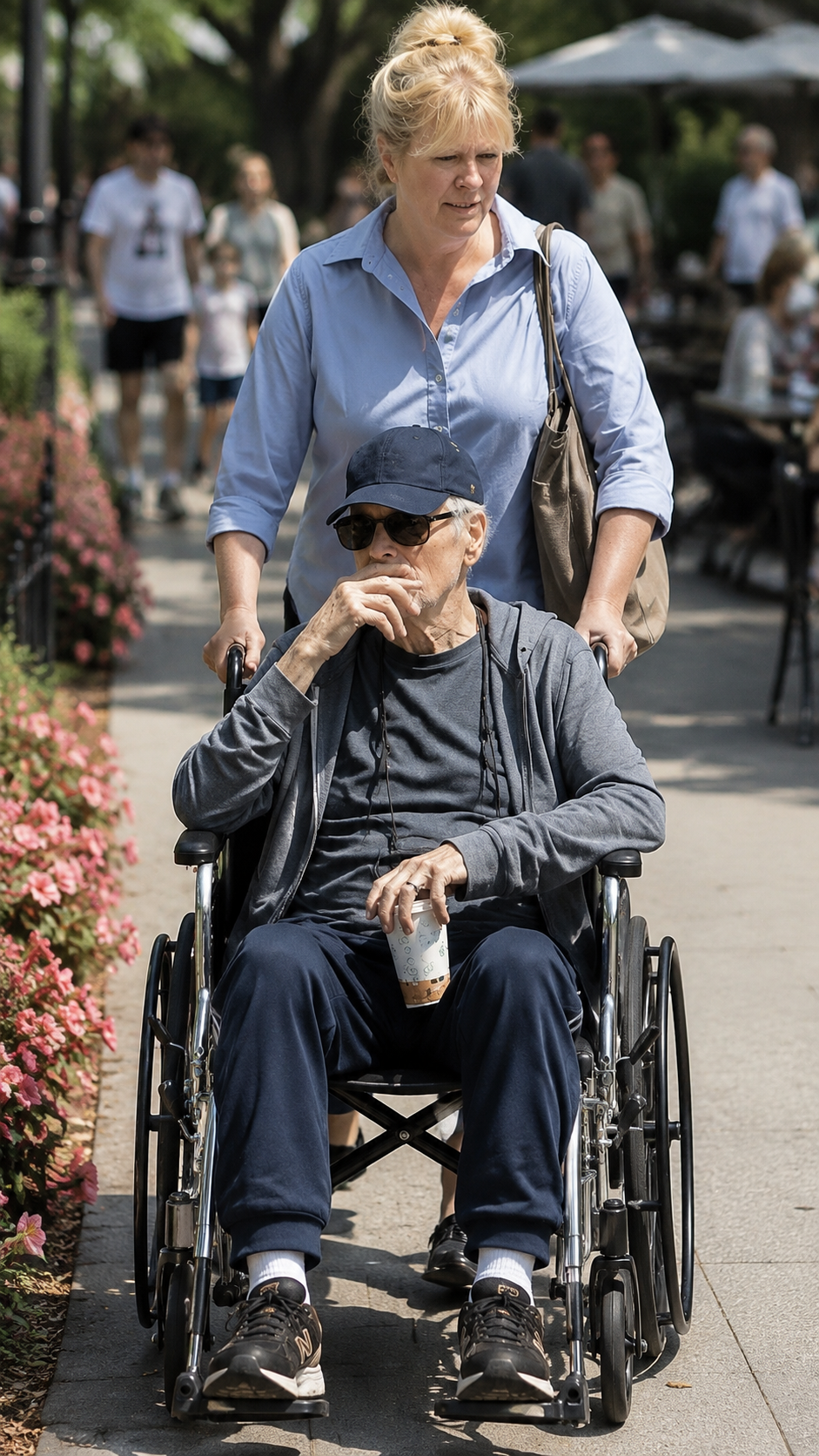
When Newman was photographed in his later years using a wheelchair and wearing a baseball cap and dark sunglasses, the images inevitably attracted attention. To audiences who remembered him from his most famous films, seeing such a physically diminished version of the actor could be startling.
Yet the photographs also represented something much more universal than celebrity.
They showed a human being growing older.
Behind the movie-star image was a man who, like everyone else, eventually had to confront the realities of age, changing abilities, and the limits of the body.
And perhaps the most remarkable part was how little interest Newman seemed to have in turning that private reality into a public spectacle.

The Man Behind the Famous Blue Eyes
It is difficult to discuss Paul Newman without mentioning his appearance.
Those blue eyes became legendary.
His face appeared on movie posters, magazine covers, photographs, advertisements, and television screens for more than half a century. He possessed the rare combination of conventional beauty and individuality that made him instantly recognizable.
But Newman never seemed entirely comfortable with the idea that his appearance was the reason people were fascinated by him.
He was an actor first.
His career demonstrated that repeatedly.
He could play charming characters, damaged characters, dangerous characters, funny characters, morally complicated characters, and deeply vulnerable men.
The common thread was never simply his looks.
It was his ability to make audiences believe him.
That quality helped Newman survive changing Hollywood fashions.
He belonged to one generation of actors, but his career continued successfully through several others.
And by the time he reached his later years, he had already become something more than a movie star.
He had become an institution.
A Career That Refused to Follow One Simple Path
Newman’s career was unusually broad.
He first became a major Hollywood star during the 1950s and 1960s, appearing in films that helped establish the image of the cool, intelligent, slightly rebellious leading man.
Movies such as Cat on a Hot Tin Roof, The Hustler, Hud, Cool Hand Luke, and Butch Cassidy and the Sundance Kid became central parts of his cinematic legacy.
Each role added another dimension.
In The Hustler, he played Eddie Felson, a talented pool player whose arrogance and ambition carried an underlying vulnerability.
In Cool Hand Luke, he became the defiant Luke Jackson, a character whose refusal to surrender made him an enduring symbol of individual resistance.
Then came Butch Cassidy and the Sundance Kid, where his chemistry with Robert Redford helped create one of the most beloved partnerships in American cinema.
By the 1980s, Newman was no longer simply the young rebel audiences had first fallen in love with.
He had matured into an actor capable of playing older, more complicated men.
And that transition became one of the most interesting aspects of his career.
He did not attempt to remain frozen in his youth.
He grew with the roles.

Winning the Oscar After Decades of Recognition
One of the most striking things about Newman’s career is that his competitive Oscar win came relatively late.
He had received multiple Academy Award nominations throughout his career, but his first competitive acting Oscar came for The Color of Money in 1987.
By then, Newman was already an established legend.
He did not need the award to prove his importance.
Yet the victory carried symbolic weight.
It was recognition from an industry that had watched his career develop for decades.
The performance also allowed him to revisit Eddie Felson from The Hustler, this time as an older man whose experiences had changed him.
That kind of role would become increasingly important in Newman’s later career.
He was no longer trying to convince audiences that he was the coolest young man in the room.
He was showing what happened to people after the room had changed.
Growing Older in an Industry Obsessed With Youth
Hollywood has always had an uncomfortable relationship with aging.
The industry celebrates youth, beauty, physical ability, and constant visibility.
Actors are often expected to remain recognizable versions of themselves indefinitely.
For someone like Newman, that expectation could have been particularly difficult.
The public remembered him as the impossibly handsome young star with bright blue eyes.
But the man himself continued aging.
His hair changed.
His face changed.
His physical abilities changed.
And eventually, he no longer appeared on screen with the same frequency.
Rather than pretending that time had stopped, Newman gradually allowed his career to evolve.
That decision deserves more attention than it sometimes receives.
There is a particular dignity in refusing to compete with your younger self.
Newman had already been that man.
He didn’t need to become him again.
The Decision to Retire
In 2007, Newman announced his retirement from acting.
His explanation was remarkably candid.
He said he no longer felt able to work at the level he wanted because he was losing his memory and confidence.
That admission was significant.
For an actor, memory is not a minor professional detail.
Lines have to be remembered.
Scenes have to be repeated.
Characters have to be inhabited.
Performances require concentration, confidence, and the ability to respond naturally in the moment.
Newman understood that.
Rather than waiting until audiences saw a version of him that he no longer recognized as good enough, he chose to step away.
It was not a dramatic Hollywood exit.
It was simply a man acknowledging a personal limit.
After roughly five decades in front of cameras, he knew himself well enough to recognize when it was time.
And there was something deeply Newman-like about that decision.
He had never seemed particularly interested in playing by Hollywood’s rules.
Why should retirement be any different?

His Final Major Screen Performances
Newman’s decision to retire did not mean his connection to acting disappeared immediately.
Some of his later work remains particularly meaningful because it showed how much emotional depth he could bring to relatively limited screen time.
One of his final live-action film roles was in Road to Perdition, released in 2002.
He played John Rooney, an aging crime boss whose relationship with Tom Hanks’ character gave the film much of its emotional complexity.
Newman’s performance earned him an Academy Award nomination for Best Supporting Actor.
By this point in his life, the actor no longer needed to dominate a movie through sheer physical presence.
He could simply sit in a room, speak quietly, and make the audience pay attention.
That was the power of experience.
The young Newman could command attention by entering a scene.
The older Newman could command attention by barely moving.
Then Came Doc Hudson
For a completely different generation, Newman’s final major acting legacy became something unexpected.
A race car.
In Pixar’s Cars, Newman provided the voice of Doc Hudson, the wise and somewhat mysterious retired racing champion who becomes an important mentor to Lightning McQueen.
The role could not have been further removed from his gritty crime dramas and rebellious young-man characters.
And yet it worked.
There was warmth in his voice.
There was authority.
There was history.
Doc Hudson was an older character who understood that talent alone was not enough and that careers eventually change.
Those themes made the casting feel almost poetic.
Newman was himself an older racing enthusiast by that stage of his life, having developed a serious passion for motorsport alongside his acting career.
So when audiences heard Doc Hudson speaking about racing, experience, competition, and the passage of time, there was something especially authentic about it.
Children heard a wise animated character.
Adults who knew Newman’s career heard something else.
They heard the voice of a legend.
Newman and His Love of Racing
Acting was only one part of Paul Newman’s identity.
He was also a passionate race-car driver.
His interest in motorsport developed into a serious competitive pursuit, and racing became one of the most important parts of his life away from Hollywood.
That passion eventually influenced his professional life as well.
Newman co-founded Newman/Haas Racing with Carl Haas, creating one of the most successful teams in American open-wheel racing.
The racing world gave Newman something Hollywood could not.
It offered a different kind of challenge.
On a racetrack, he was not simply Paul Newman the movie star.
He was a driver.
He had to learn.
He had to compete.
He had to accept mistakes.
He had to improve.
That distinction mattered.
It allowed him to enter another world without relying on the celebrity identity he had built in Hollywood.
A Life That Became Bigger Than Movies
Perhaps the most surprising part of Newman’s legacy is that acting eventually became only one piece of the story.
He and his friend A. E. Hotchner founded Newman’s Own in 1982.
What began with salad dressing eventually became a much larger food company, and the organization became known for donating profits to charitable causes.
The idea was unusually straightforward.
Make a product.
Sell it.
Give the profits away.
Over time, Newman’s Own and its foundation became associated with substantial charitable giving, particularly in areas involving children and communities.
This was not a publicity side project.
Philanthropy became a serious part of Newman’s life.
His name became associated not only with famous films but with the idea that success could be used to help other people.
That helped change the way many people viewed him.
He was no longer simply the handsome actor from old movies.
He was someone who had built a legacy outside the entertainment industry.
The Importance of Privacy
Newman was also famously protective of his private life.
His marriage to actress Joanne Woodward became one of Hollywood’s most enduring relationships.
The couple married in 1958 and remained together until Newman’s death in 2008.
Their relationship became famous partly because it seemed to exist outside the normal Hollywood cycle of constant publicity.
They worked together.
They raised a family.
They built a life away from the camera.
And although the public remained fascinated by them, they generally avoided turning their marriage into an entertainment product.
That restraint was increasingly unusual.
Newman once became associated with a famous quip about why he remained faithful to Woodward despite being surrounded by attractive women.
The exact wording has been debated over the years, but the sentiment became part of his mythology: he understood what he had at home and had no interest in throwing it away for temporary excitement.
Whether remembered as a joke or a philosophy, it captured something about the way Newman was perceived.
He valued loyalty.
He valued privacy.
And he valued a life that existed beyond the public gaze.
Joanne Woodward and the Later Years
Woodward was more than Newman’s wife.
She was also a respected actress in her own right, and their partnership was deeply intertwined with their personal and professional lives.
As Newman grew older, their private life became increasingly important.
The world might remember him as Luke Jackson, Butch Cassidy, Eddie Felson, or countless other characters.
But inside their home, he was simply Paul.
That distinction is important when looking at photographs from his later years.
A photograph of an aging celebrity can make viewers forget that the person in the picture has an entire life outside the frame.
Family.
Friends.
Memories.
Private conversations.
Ordinary mornings.
Ordinary evenings.
Things that never become headlines.
Newman appeared to understand that distinction better than most.
The Final Chapter
Newman’s health became a subject of public attention during the final period of his life.
But he did not turn his illness into a public performance.
In August 2008, reports emerged that he was receiving treatment for cancer.
Newman died at his home in Westport, Connecticut, on September 26, 2008.
He was 83 years old.
The news marked the end of a career that had stretched across more than five decades.
But it did not feel like the disappearance of a celebrity.
It felt like the closing of an era.
By then, Newman had already lived several different lives.
Actor.
Director.
Racing driver.
Businessman.
Philanthropist.
Husband.
Father.
Friend.
And cultural icon.
Why Those Later Photographs Stay With People
There is something about photographs of aging celebrities that can be unexpectedly emotional.
Part of the reaction comes from recognition.
We remember people as they were when we first encountered them.
Maybe Newman was first seen in Cool Hand Luke.
Maybe it was Butch Cassidy and the Sundance Kid.
Maybe it was The Sting.
Maybe it was The Color of Money.
Or perhaps, for a younger generation, it was simply the voice of Doc Hudson in Cars.
Everyone has their own version of Paul Newman.
That is why seeing him in old age could feel almost disorienting.
The face remained recognizable, but time had changed it.
The body moved more slowly.
The famous physical confidence had given way to vulnerability.
And suddenly, the audience was forced to confront something it would rather avoid.
The people who created our favorite memories are aging too.
Sometimes they leave us.
Sometimes we simply stop seeing them.
Either way, the passage of time becomes impossible to ignore.
He Never Needed to Pretend He Was Young Forever
Perhaps one of the greatest lessons of Newman’s later years was his willingness to accept change.
He didn’t need to keep making movies simply because the public wanted another Paul Newman performance.
He didn’t need to prove that he could still do what he had done at 30.
He knew what his standards were.
And when he believed he could no longer meet them, he walked away.
That takes confidence.
It is easy to continue chasing applause.
It is much harder to decide that you have already accomplished enough.
Newman made that decision while his name still carried enormous weight.
He chose quality over quantity.
Privacy over spectacle.
Life over the demands of celebrity.
The Legacy That Remains
More than fifteen years after his death, Paul Newman’s influence remains surprisingly broad.
His films continue to be watched.
His performances continue to be studied.
His racing legacy remains important.
Newman’s Own remains connected to his philanthropic vision.
And his relationship with Joanne Woodward remains one of the most enduring partnerships associated with classic Hollywood.
But perhaps his greatest legacy is more difficult to define.
It is the image of a man who refused to let one part of his life become the whole story.
He was a movie star, but he did not live only for movies.
He was famous, but he did not appear to crave constant attention.
He was extraordinarily successful, but he continued searching for challenges outside his primary profession.
And when age eventually forced him to slow down, he did not need to turn the process into a dramatic farewell.
He simply accepted it.
The Man After the Spotlight
When the lights go out, every celebrity eventually becomes human again.
The cameras stop.
The crowds disappear.
The interviews end.
The costumes are put away.
And eventually, the person remains.
That is perhaps what makes Paul’s Newman’s later years so poignant.
The world had spent decades celebrating the image of the impossibly cool movie star.
But his final chapter reminded audiences that the real achievement was not remaining young forever.
It was living a full life.
Newman acted.
He raced cars.
He built businesses.
He supported charitable causes.
He loved his family.
He made mistakes.
He aged.
And eventually, he stepped away.
There is no tragedy in acknowledging that.
If anything, there is something profoundly reassuring about it.
Because the goal was never to defeat time.
The goal was to live well while time was passing.
And Newman did.
A Different Kind of Hollywood Ending
Hollywood loves endings.
A character rides into the sunset.
The credits roll.
The music rises.
The audience knows exactly when the story is finished.
Real life is rarely that clean.
Paul Newman’s story did not end with one final dramatic performance.
It gradually became quieter.
The movies became less frequent.
The public appearances became fewer.
The spotlight moved elsewhere.
And eventually, the man who had spent so much of his life being watched was allowed to become private again.
Maybe that is the most fitting ending of all.
Paul Newman spent decades giving audiences pieces of himself through his work.
He gave them unforgettable characters.
He gave them laughter, anger, rebellion, heartbreak, wisdom, and charm.
He gave them stories that survived long after the theaters emptied.
But he also understood that there was a life that belonged only to him.
And when the time came to step away, he did so without needing one final grand gesture.
He simply left the stage.
What We Remember
Today, people still remember the blue eyes.
They remember Luke Jackson refusing to break.
They remember Butch Cassidy smiling beside the Sundance Kid.
They remember Eddie Felson returning to the pool table.
They remember the quiet intensity of Road to Perdition.
And for an entirely different generation, they remember Doc Hudson telling Lightning McQueen that there was more to life than winning.
But perhaps we should remember something else too.
We should remember the older Paul Newman.
The man who understood that bodies change.
The actor who knew when he could no longer perform at the standard he demanded of himself.
The husband who valued his private life.
The racer who found another passion beyond Hollywood.
The philanthropist who turned his success into something that could help others.
And the human being who eventually became vulnerable in exactly the same way every human being does.
That is not a lesser version of Paul Newman.
It is the complete version.
The young star was extraordinary.
The older man was human.
And somehow, seeing both versions together makes the entire story more meaningful.
Paul Newman didn’t remain frozen in the photographs of his youth.
He lived long enough for the world to see him change.
And perhaps that is why his legacy feels so enduring.
He didn’t simply teach audiences how to shine under the spotlight.
In his final years, he quietly demonstrated something harder:
how to step away from it with dignity.
And when the curtains finally fell, what remained was not simply the memory of a movie star.
It was the memory of a man who had lived a remarkably full life — and had the courage to let the world see that, eventually, even legends grow old.